
Heart Line Palm Reading: Where It Sits and What Each Pattern Means
A practical guide to heart line palm reading — where the heart line sits, how its ending point, curve, and length change the meaning, and what each classical pattern actually tells you about how someone loves.
What does the heart line tell you, and how do you read it? Hold your hand flat, palm up, and find the uppermost long horizontal line running below your fingers — that is the heart line (sometimes nicknamed the love line). It describes how a person loves: how deeply they feel, how openly they show it, and whether emotion or reason tends to win when the two collide. It does not predict who you will marry or when.
This guide describes the Cheiro / Indian-tradition reading of the heart line, treats it as an emotional-temperament marker rather than a prediction, and is honest about the limits — the same tone as the 9-step palm reading guide and the marriage line guide. If you finish this page, you will know how the heart line's ending point, curve, length, and markings each change the reading, and where the tradition genuinely overreaches.
What Is the Heart Line in Palm Reading?
The heart line is the topmost of the three major lines — above the head line, which sits below it, and the life line, which curves around the thumb. It runs roughly horizontally across the upper palm, just under the base of the fingers.
Where the marriage line records the unions that formed in someone's life, the heart line records how they love in the first place — the affective style underneath any particular relationship. Cheiro treats it in Palmistry for All (1916) as the line that governs "the affections and the emotional nature." It is the cleanest single read of emotional temperament on the hand, but it is only ever half the story: the head line below it describes how someone thinks, and the two must be read together.
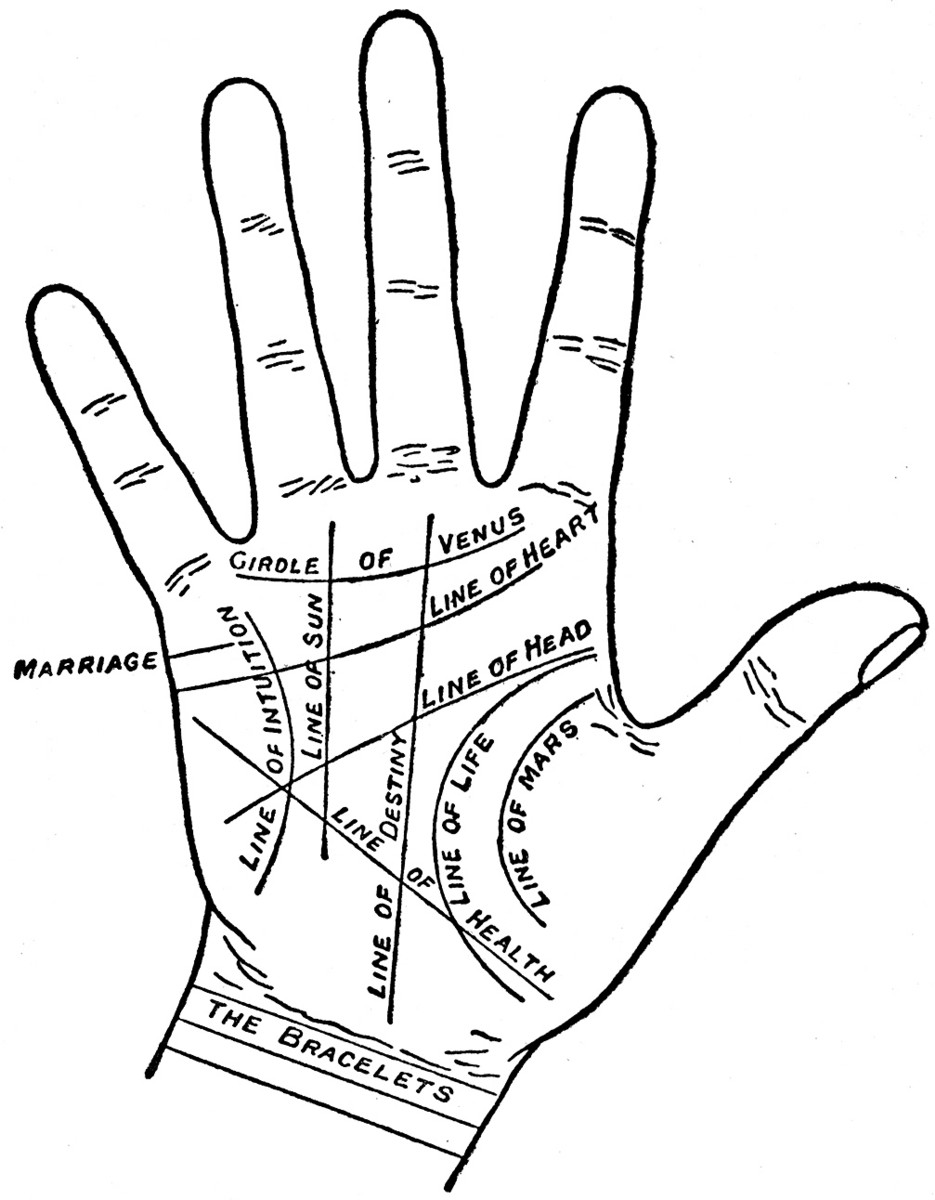
The classic palmistry overview from Cheiro's Palmistry for All (1916, public domain). The heart line is the topmost horizontal line, sitting below the fingers and above the head line.
Where the Heart Line Sits on Your Hand
Hold your hand flat, palm up. The heart line is the highest long horizontal line on the palm — the one closest to your fingers. Below it runs the head line, and below that the life line sweeps around the base of the thumb. If you can find those three, the topmost one is the heart line.
The line usually begins at the percussion edge (the outer side, under the pinky) and travels across the palm toward the index or middle finger. A common beginner mistake is to confuse a high, arcing girdle of Venus — a secondary line above the heart line, under the middle and ring fingers — with the heart line itself. The girdle is shorter, sits higher, and means heightened sensitivity; the heart line is the long base line of the upper palm.
Which Direction to Read the Heart Line
This trips up nearly every beginner, so it is worth being explicit. Cheiro and most of the classical tradition read the heart line from the percussion edge toward the fingers — that is, the line ends under the fingers, and where it ends is the part you interpret. Many modern palmists describe it the opposite way, calling the finger-side the "start."
The terminology does not matter; the finger-side terminus is the meaningful feature either way. To avoid confusion, this guide always refers to "where the heart line ends under the fingers." That ending point is the single most informative thing about the line.
Where the Heart Line Ends: The Single Most Important Feature
The point under the fingers where the heart line terminates sets the basic emotional posture. The three classical endings, in order from idealistic to physical:
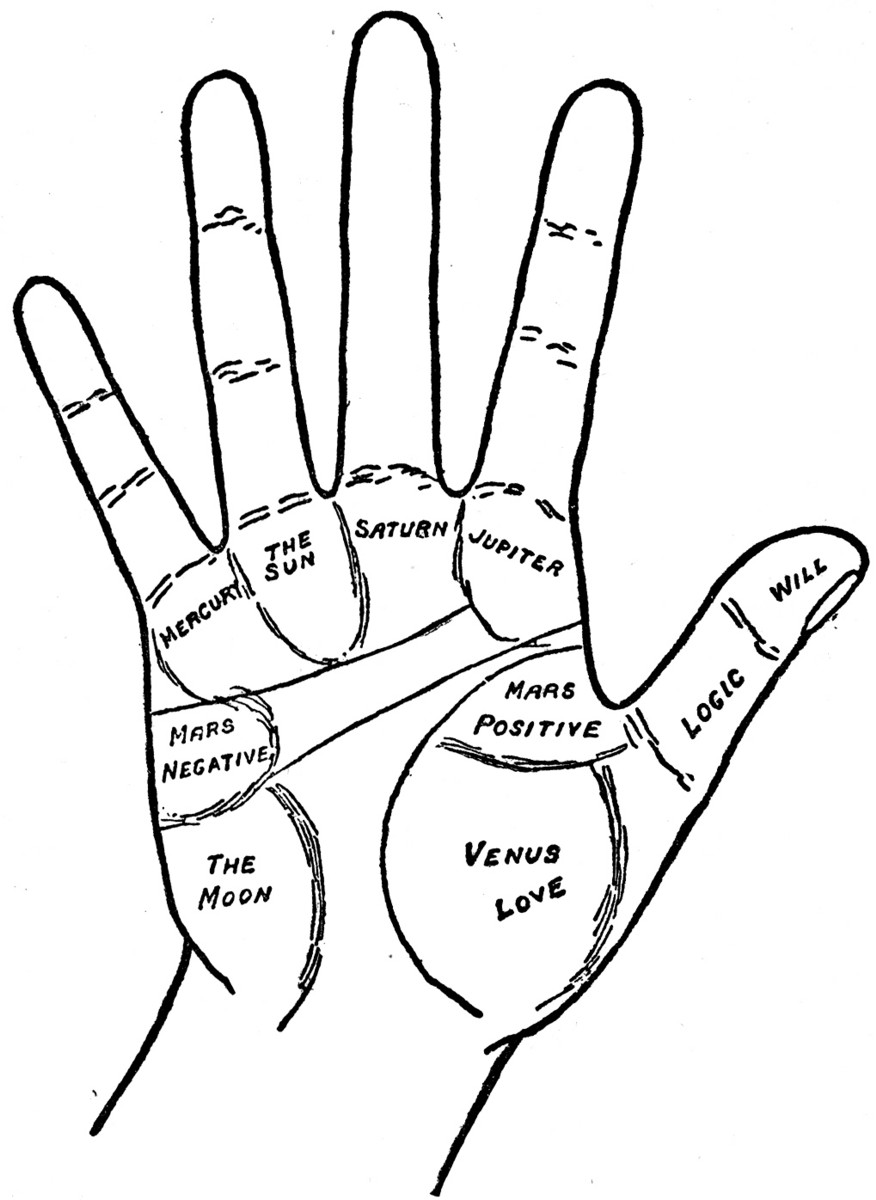
The seven mounts (Cheiro, 1916). The heart line's ending under the Jupiter (index) or Saturn (middle) mount is what changes its meaning most.
Ending under the Jupiter (index) finger
This is the idealistic heart line. It marks someone with high standards in love, a need to genuinely admire a partner, and a tendency to be selective. At its best this is principled, devoted, romantic. At its worst it sets a bar few people can clear — these are the clients who describe a long string of "almost right" partners. Honest note: idealism reads as either loyalty or perpetual dissatisfaction depending on the rest of the hand, so check the head line before deciding which.
Ending between the Jupiter and Saturn fingers
This is the balanced ending — the most common and, classically, the easiest emotional temperament. It blends warmth with realism: the person wants to admire a partner but does not demand perfection. Most well-functioning heart lines land here.
Ending under the Saturn (middle) finger
This is the more self-directed, physical reading. Affection here is driven more by desire and personal need than by romantic idealism. The classical texts can be harsh about this ending, but in practice it usually just marks someone honest about what they want rather than someone performing romance. A short heart line that stops abruptly under Saturn is the strongest version of this pattern.
Curved vs Straight: The Two Basic Heart Line Types
After the ending point, the shape of the line is the next thing to read. There are two basic types, and most hands lean clearly toward one.
Curved heart line (curving up toward the fingers): the expressive, demonstrative type. These people show affection openly, act on feeling, and tend to be the ones who say it first. The deeper the upward curve, the more outwardly emotional and physically affectionate the temperament. Cheiro associates the curved line with the "active" or "physical" heart.
Straight heart line (running flat across the palm): the reserved, receptive type — the "mental heart." These people feel just as deeply but process emotion internally before showing it. They are often loyal and steady, but slower to express affection and easy to misread as cold. A very straight, low heart line that runs toward the head line marks someone who consistently lets reason override feeling.
Neither type is better. A curved heart line with a weak head line can be impulsive in love; a straight heart line with a strong head line is often the most stable long-term partner on the page.
Heart Line Length and Depth
Length. A long heart line stretching most of the way across the palm marks someone whose emotional life is central to who they are — relationships occupy a large share of their attention. A short heart line marks someone more self-contained emotionally, for whom other drives (work, ideas, independence) compete with romance. Short is not "loveless"; it is "love is one priority among several."
Depth. A deep, clearly cut heart line marks strong, focused affection — fewer attachments, held intensely. A faint or shallow line marks a lighter, more diffuse emotional life. A broad, shallow line often reads as someone who feels widely but not deeply, scattering affection across many people.
The Heart Line Patterns Worth Knowing
Beyond ending point, curve, and length, a handful of markings come up repeatedly. For each I give the classical reading and an honest note on where it gets over-read.
A forked end
A heart line that forks at the finger end is one of the best patterns to have. The classic balanced fork sends one branch to under the index finger and one to between the fingers, blending idealism with realism — emotionally flexible, able to both admire and accept a partner. A downward fork dipping toward the head line reads as emotion being pulled toward reason: someone who talks themselves out of their own feelings.
Branches rising upward
Small lines branching upward off the heart line are classically read as positive emotional events or warm attachments. Branches dropping downward read as disappointments or losses. In practice I treat a cluster of fine upward branches as an expressive, optimistic emotional nature more than as a list of literal events.
A chained or wavy line
A chained heart line (made of little linked loops) or a wavy one reads as emotional turbulence — frequent ups and downs, sensitivity, being easily hurt, and sometimes flirtatiousness or indecision in attachment. Like a chained marriage line, this describes a temperament inside relationships, not a single event.
A broken line
A clear break in the heart line is the classical sign of an emotional rupture — grief, heartbreak, or a defining loss. If the two segments overlap, the reading is recovery and reconnection; a clean gap reads as a more lasting emotional shift. I only treat a break as significant when another part of the hand confirms the same story.
An island on the line
An island — a small loop in the middle of the line — marks a difficult emotional period, often a stretch of depression, loss, or relationship strain. The classical reading treats it as temporary: once the island closes, the line continues, and so does the person's emotional life.
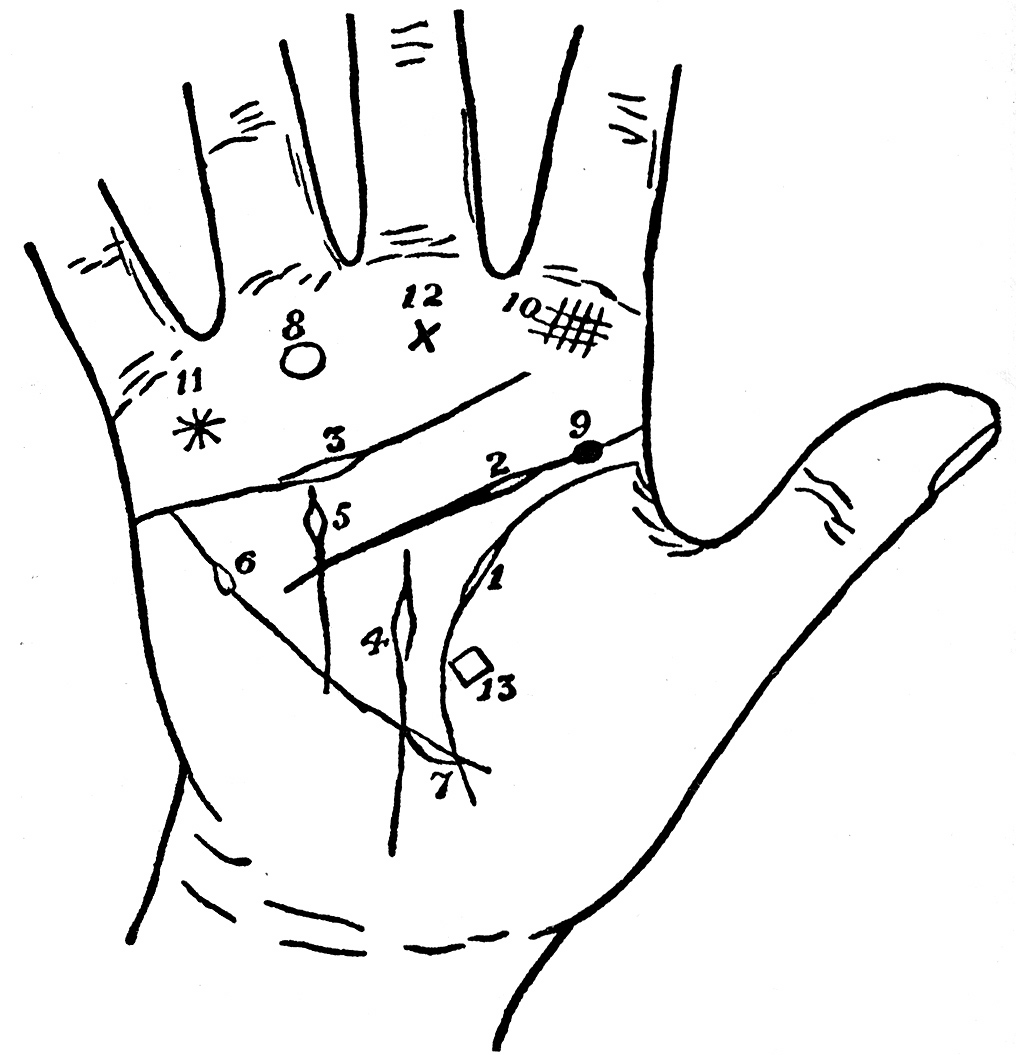
Cheiro Plate XXII — the six classical marks (island, circle, spot, grille, star, square) that can appear on the heart line and modify its meaning.
When the Heart Line Merges with the Head Line (Simian Line)
In some hands the heart line and head line fuse into a single crease running straight across the palm. This is the simian line. Classically it points to an intense, all-or-nothing way of fusing emotion and logic — people who do not separate "how I feel" from "what I think," and who tend toward focused, single-minded intensity.
The honest note here matters more than usual: the simian line is a normal human variation found in many well-adjusted people, and it has been badly stigmatized by association with medical claims it does not deserve. Read it as a temperament marker — concentrated, sometimes inflexible — and never as a diagnosis or a warning.
How the Heart Line Relates to the Head and Life Lines
The heart line is never read alone. Its relationship to the head line directly below it is the whole game:
- Heart line dominant (deeper, longer, more prominent than the head line): feeling tends to lead. Decisions get made from the gut and the heart, sometimes against the person's own better judgment.
- Head line dominant: reason tends to win. Emotion is real but gets filtered through analysis before it acts.
- Wide gap between the two lines: an open, independent nature — comfortable acting on its own terms. A narrow gap: a more cautious, controlled temperament where feeling and thinking stay tightly coupled.
The life line adds vitality and physical energy to the picture, but for emotional reading the heart-versus-head balance is what you check first. A reading that ignores the head line and treats the heart line in isolation is exactly the mistake that produces dramatic, useless "predictions."
Reading the Heart Line on Both Hands
The dominant / non-dominant rule from the main palm reading guide applies cleanly. The dominant (writing) hand shows your present-day emotional reality; the non-dominant hand shows the emotional temperament you inherited. When both hands carry a similar heart line, the reading is strong and stable. When they disagree sharply — say, an idealistic Jupiter-ending line on one hand and a physical Saturn-ending line on the other — the person is usually consciously reshaping how they were taught to handle feelings, either opening up beyond a guarded upbringing or reining in an inherited intensity.
Limits: What the Heart Line Cannot Tell You
To match the honest-tradeoff tone of the rest of this site, here is what the heart line cannot reliably tell you:
- Who you will love, or when. The heart line describes how you love, not the people you meet. For union markings, palmistry looks at the marriage lines — and even those name no one.
- Whether a relationship will last. Longevity depends on two people and on circumstances no single line tracks.
- Your sexual orientation or a partner's gender. These claims circulate online and have no basis in classical palmistry.
- A medical or mental-health diagnosis. A chained line, an island, or a simian line is a temperament marker, not a clinical finding, and must never be read as one.
What the heart line can describe is the texture of how someone feels and shows love: idealistic or physical, expressive or reserved, emotionally led or reason-led, steady or turbulent. Read at that level, it is one of the most useful lines on the hand. Read past it, you are guessing.
Frequently Asked Questions
What does the heart line mean in palm reading?
The heart line is the topmost of the three major lines, running horizontally across the upper palm below the fingers. It describes how a person loves — emotional depth, warmth, idealism, and how openly they express feeling — rather than predicting specific relationships. It is read alongside the head line and the marriage line, never on its own.
Where exactly is the heart line on the hand?
Hold your hand flat, palm up. The heart line is the uppermost long horizontal line, sitting between the base of the fingers and the head line below it. It usually starts at the percussion edge under the pinky and runs across toward the index or middle finger.
What does a curved heart line mean?
A heart line that curves upward toward the fingers belongs to the warm, expressive, demonstrative type — someone who shows affection openly and acts on feeling. The deeper the curve, the more outwardly emotional the temperament. It is the classic "physical / active heart" reading.
What does a straight heart line mean?
A heart line that runs flat and straight across the palm belongs to the reserved, receptive type — someone who feels deeply but processes emotion mentally before showing it. Classical palmistry calls this the "mental heart" — loyal and steady, but slower to express affection out loud.
What does it mean if the heart line ends under the index finger?
A heart line ending under the Jupiter (index) finger is the idealistic pattern — high standards in love, a need to admire a partner, and a tendency to be choosy. At its best it is principled devotion; at its worst it sets a bar few partners can clear.
What does it mean if the heart line ends under the middle finger?
A heart line ending under the Saturn (middle) finger is the more self-directed, physical reading — affection driven by desire and personal need more than romantic idealism. It is not a flaw; it usually marks someone honest about what they want rather than performing romance.
What does a forked heart line mean?
A fork at the end of the heart line, with one branch under the index finger and one between the fingers, is classically the most balanced pattern — it blends idealism with realism. A downward fork toward the head line reads as emotion being pulled toward reason, often someone who talks themselves out of feelings.
What does a broken heart line mean?
A break in the heart line is the classical sign of an emotional rupture or a period of grief. If the two segments overlap it usually means recovery and reconnection; a clean gap reads as a more lasting emotional shift. Only treat it as significant when the rest of the hand agrees.
What does a chained heart line mean?
A chained or wavy heart line reads as emotional turbulence — frequent ups and downs, sensitivity, and a tendency to be easily hurt or pulled between feelings. It describes a temperament inside relationships, not a single event.
What is a simian line and how does it relate to the heart line?
A simian line is a single crease where the heart line and head line merge into one line running straight across the palm. It points to an intense, all-or-nothing way of fusing emotion and logic. It is a normal human variation, not a defect, and should never be over-read.
Which hand should I read for the heart line?
Read the dominant — writing — hand for your present-day emotional reality, and the non-dominant hand for your inherited emotional temperament. If the two disagree sharply, the person is usually consciously reshaping how they were taught to handle feelings.
Can the heart line predict who I will marry?
No. The heart line describes how someone loves, not who they will meet or when. For union-specific markings, palmistry looks at the marriage lines on the percussion edge, and even those describe attachment patterns rather than naming a person or a date.
Is the heart line the same as the love line?
Yes — love line is just a popular nickname for the heart line. Classical texts like Cheiro's Palmistry for All (1916) call it the heart line or line of heart. It is distinct from the marriage line, which is a separate short horizontal mark below the pinky.
Where to Go Next
If you want the full framework — hand shape, thumb, mounts, all four major lines, the dating method, and the mistakes most beginners make — read the 9-step palm reading guide. The heart line is one piece of a larger reading, and the head line directly below it changes its meaning more than any single marking does.
For the thinking-style side — how someone reasons, decides, and processes information — see the head line guide. The heart line tells you how someone loves; the head line tells you how they think.
For the reputation and talent side — how you are recognized and what you are known for — see the sun line guide. The heart line tells you how someone loves; the sun line tells you how they are seen by the world.
For the relationship-specific markings — the short horizontal lines below the pinky — see the marriage line guide. The heart line tells you how someone loves; the marriage lines record what unions formed.
If you want a structured reading of your own palm in about a minute, scan your hand on the Scan page. It walks through the same classical framework this guide draws from and flags the heart-line patterns it finds.
Image credits. All plates on this page are reproduced from Cheiro's Palmistry for All (G.P. Putnam's Sons, 1916), now in the public domain. Scans courtesy of Project Gutenberg.
Health Line Palm Reading: Where It Sits and What It Tells You
A practical guide to health line palm reading — where the health line sits, whether you have one, and what classical palmistry actually says about health markers on the hand.
Life Line Palm Reading: Where It Sits and What Each Pattern Means
A practical guide to life line palm reading — where the life line sits, how its length, curve, and markings change the meaning, and what each classical pattern actually tells you about vitality and life path.