
Sun Line in Palm Reading: Where It Sits and What Each Pattern Means
A practical guide to sun line palm reading — where the sun line sits, how its depth, length, and markings change the meaning, and what each classical pattern actually tells you about reputation, talent, and success.
What does the sun line tell you, and how do you read it? Hold your hand flat, palm up, and look for a vertical line running from the upper palm toward the base of the ring finger — that is the sun line (sometimes called the line of Apollo or the line of success). It describes your reputation, public recognition, talent, and the quality of your creative or professional output. Not everyone has one, and that is perfectly normal.
This guide describes the Cheiro / Indian-tradition reading of the sun line, treats it as a reputation and talent marker rather than a fame prediction, and is honest about the limits — the same tone as the 9-step palm reading guide and the fate line guide. If you finish this page, you will know how the sun line's presence, depth, length, and markings each change the reading, and where the tradition genuinely overreaches.
What Is the Sun Line in Palm Reading?
The sun line is a vertical line that runs from the upper palm toward the base of the ring finger (the Apollo or Sun mount). It is one of the minor lines — less commonly discussed than the life, heart, head, or fate lines — but when present, it adds a layer of meaning that those major lines cannot provide.
Where the fate line records your career direction and external influence and the heart line records how you love, the sun line records how you are seen by the world — your reputation, your talent, and the quality of what you produce or express. Cheiro treats it in Palmistry for All (1916) as the line that governs "the reputation, the success, and the brilliancy of the career." It is the line people ask about most when they want to know "will I be recognized for what I do?"
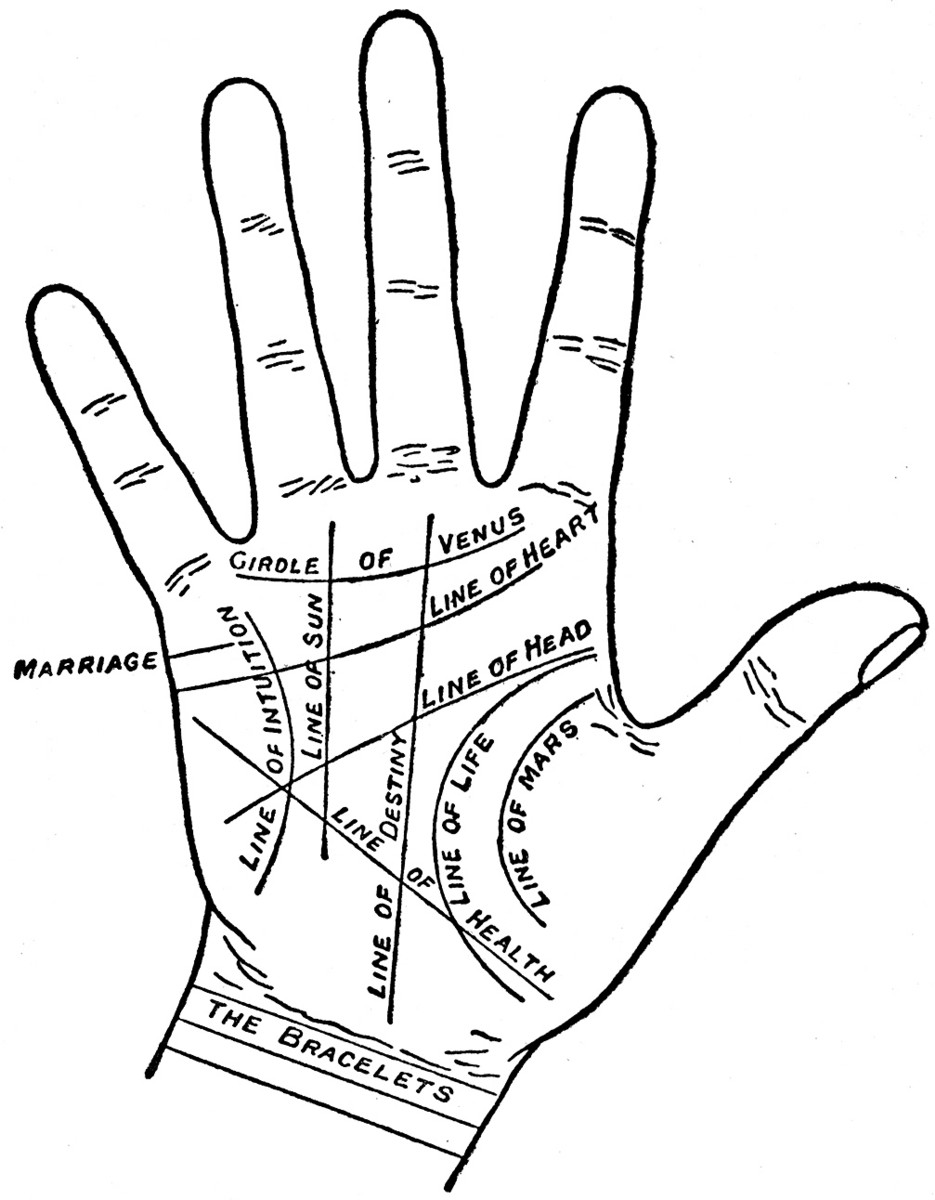
The classic palmistry overview from Cheiro's Palmistry for All (1916, public domain). The sun line runs vertically toward the base of the ring finger, parallel to the fate line.
Where the Sun Line Sits on Your Hand
Hold your hand flat, palm up. The sun line, when present, runs vertically from the upper palm toward the base of the ring finger. It sits on the outer side of the palm — the side closer to the little finger — and runs parallel to the fate line, which sits closer to the center of the palm.
The sun line typically starts somewhere in the upper half of the palm and runs upward toward the ring finger mount. Some people have a sun line that begins at the wrist and runs the full length of the palm; others have a shorter line that only appears in the upper section. Both are normal.
Not everyone has a clear sun line. Some people have a deep, well-defined line. Others have a faint line that only appears under certain lighting. And many people have no sun line at all — which is not a problem and does not mean they will go unrecognized. It simply means their success and reputation are expressed through other markers on the hand.
A common beginner mistake is to confuse the sun line with the fate line. Both run vertically, but the fate line runs toward the middle finger (career direction) while the sun line runs toward the ring finger (reputation and talent). They are parallel but distinct.
Which Direction to Read the Sun Line
The sun line is read from the starting point upward toward the ring finger. The starting point corresponds roughly to when the person's talent or reputation began to develop, and the line progresses upward as age advances. Like all palm dating, this is a rough guide — a general age band rather than a precise year.
The depth and clarity of the line at different points along its length tells you about the quality of recognition during those life stages. A deep, clear section marks a period of strong visibility or talent expression; a faint or broken section marks a period when recognition faded or talent went unused.
What Does the Sun Line Mean in Palm Reading?
The sun line describes three things, in order of reliability:
-
Reputation and public recognition. A deep, well-defined sun line marks someone who is naturally noticed — their work, personality, or talent draws attention and praise. A faint or absent sun line marks someone whose success comes through effort and persistence rather than natural visibility.
-
Talent and creative expression. The sun line is closely associated with artistic ability, creative output, and the quality of what a person produces. A strong sun line often appears on the hands of artists, performers, writers, and others whose work is publicly visible.
-
The quality of success. Where the fate line describes the direction of your career, the sun line describes the quality of the outcome — whether your work is recognized, appreciated, and remembered. A person with a strong fate line but no sun line may have a successful career that goes largely unnoticed; a person with a strong sun line but a faint fate line may be widely recognized for something that is not their primary career.
What the sun line does not describe is fame in a celebrity sense. It does not predict whether you will become famous, wealthy, or widely known. It describes the quality of recognition — how you are seen, not how many people see you. A deep sun line on a teacher's hand marks someone whose students remember and respect them; it does not mark a celebrity.
Sun Line Depth: Deep vs Faint
Deep sun line. A deep, clearly cut sun line — a groove you can trace easily — marks strong natural talent, charisma, or public recognition. These people often have a gift that draws attention: artistic ability, leadership presence, or a personal quality that makes them stand out. The deeper the line, the more consistent and lasting the recognition.
Faint sun line. A faint or shallow sun line marks someone whose talent or recognition is more subtle. These people may have real ability but do not attract attention easily. Their success comes through persistence and effort rather than natural visibility. It is not a weakness — it is a different relationship with recognition.
No sun line. Many people have no sun line at all. This does not mean they will fail or go unrecognized. It usually marks someone whose success comes through hard work and persistence rather than natural talent or public visibility. Many highly successful businesspeople, engineers, and professionals have no sun line — they build their reputation through the fate line and other markers instead.
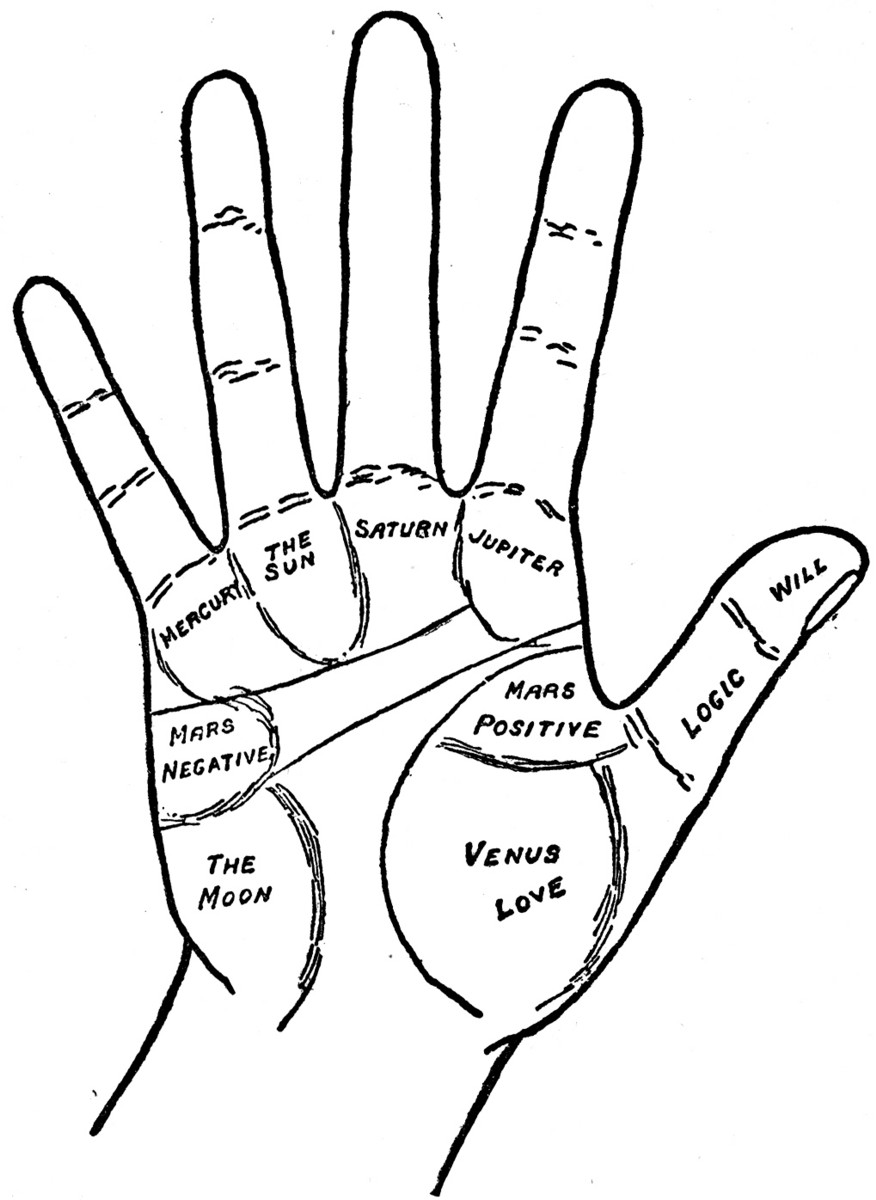
The seven mounts (Cheiro, 1916). The sun line runs toward the Apollo (Sun) mount under the ring finger — the mount of creativity, reputation, and public recognition.
Where the Sun Line Starts
Where the sun line begins tells you about the source of talent or recognition in someone's life. The three classical starting points:
Starting from the wrist
A sun line that begins clearly at the wrist and runs the full length of the palm marks someone whose talent or recognition was present from early life. These people often showed ability or charisma from a young age and maintained it throughout their lives. It is the most uncommon starting point — a full-length sun line is relatively rare.
Starting from the mid-palm
A sun line that begins in the middle of the palm — with no clear starting point near the wrist — marks someone whose talent or recognition developed later in life. These people may have spent their early years without clear direction before their ability or reputation emerged. The later the start, the later the recognition.
Starting from the head line
A sun line that begins at or near the head line marks someone whose success came through intellectual effort, education, or deliberate planning rather than natural talent. These people build their reputation through study, strategy, or professional expertise. It is a common starting point for academics, professionals, and those whose success is built on knowledge rather than innate ability.
The Sun Line Patterns Worth Knowing
Beyond starting point and depth, a handful of markings come up repeatedly on the sun line. For each I give the classical reading and an honest note on where it gets over-read.
Broken sun line
A clear break in the sun line is the classical sign of a setback in reputation or a period when recognition faded — a career scandal, a creative block, a time when the person's work went unnoticed, or a public failure. If the line resumes after the break, the reading is interruption followed by recovery — the person went through a rough patch but rebuilt their reputation. A clean gap signals a more dramatic loss of visibility.
A break that appears on both hands in the same place is more significant than one that appears on only one hand. If only the dominant hand shows a break, the setback is likely related to current circumstances; if only the non-dominant hand shows it, the setback may relate to a missed opportunity or unrealized potential.
Forked sun line
A fork at the end of the sun line, splitting toward the ring finger, marks dual talents or success in two different fields. These people often have ability in more than one area — art and science, music and business, writing and teaching. The wider the fork, the more distinct the two areas of talent.
A fork at the start of the sun line, near the wrist, reads as a late bloomer — someone whose talent or recognition developed after an uncertain beginning. If the fork is narrow, the transition is gradual; if wide, the change in direction is more dramatic.
Island on the sun line
An island — a small loop in the middle of the sun line — marks a difficult period for reputation or creative output, often involving a loss of direction, a creative block, or a time when the person's work was not appreciated. The larger the island, the longer or more significant the difficult stretch. Once the island closes and the line continues, the person's reputation recovers.
Star on the sun line
A star — a small asterisk-like mark on the sun line — is classically read as a sudden breakthrough in recognition or a stroke of creative luck. It marks an unexpected opportunity, a moment of public acclaim, or a time when the person's talent was suddenly recognized. The honest note: stars are rare and easy to over-interpret. Only treat it as significant if the mark is clear and unambiguous.
Cross on the sun line
A cross on the sun line is classically read as an obstacle to reputation — a period when the person's talent or work was misunderstood, criticized, or blocked. It can also mark a moment of sacrifice, when the person gave up public recognition for personal reasons.
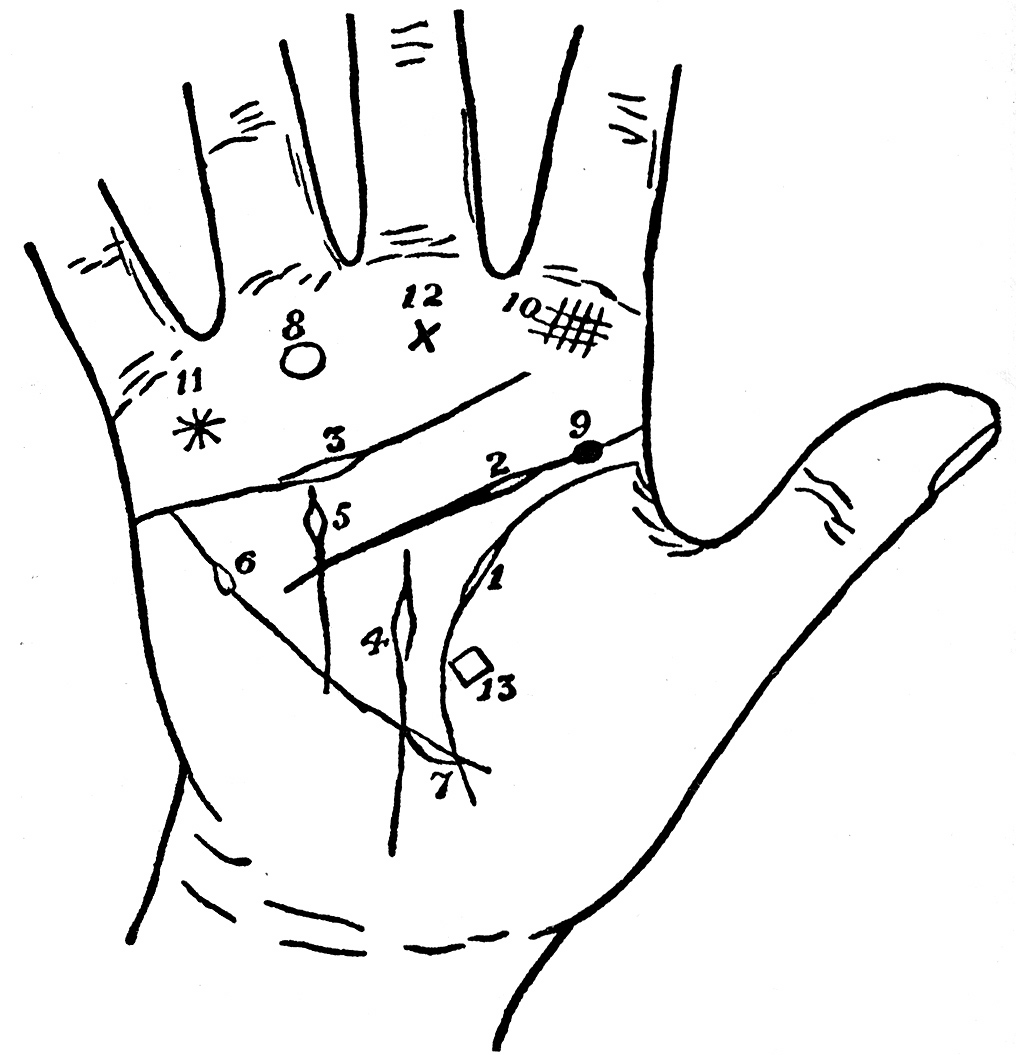
Cheiro Plate XXII — the six classical marks (island, circle, spot, grille, star, square) that can appear on the sun line and modify its meaning.
Sun Line and Fate Line Relationship
The relationship between the sun line and the fate line is one of the most informative combinations on the hand. Together, they tell you about the balance between career direction and public recognition.
Both lines strong
When both the fate line and the sun line are deep and clear, the reading is strong career direction paired with strong public recognition. These people often have a clear career path that is also publicly visible — they are known for what they do. This is the combination most commonly associated with successful professionals, public figures, and recognized experts.
Strong fate line, no sun line
When the fate line is deep but the sun line is absent or faint, the person has a clear career path but may not receive much public recognition. They do good work, but it goes largely unnoticed. This is common in behind-the-scenes roles — engineers, analysts, managers — where the work is important but not publicly visible.
Strong sun line, faint fate line
When the sun line is deep but the fate line is faint or absent, the person is widely recognized but may lack a clear career direction. They may be known for something that is not their primary career, or their reputation may precede their actual professional path. This combination appears on the hands of artists, performers, and public personalities whose fame is tied to talent rather than career structure.
Both lines absent
When neither the fate line nor the sun line is present, the person's life path and reputation are both self-determined. This is not a negative sign — it simply marks someone who builds their life and reputation through personal effort rather than external structure. Many entrepreneurs and independent thinkers show this combination.
Reading the Sun Line on Both Hands
The dominant / non-dominant rule from the main palm reading guide applies to the sun line. The dominant (writing) hand shows your present-day reputation and talent expression as you are living it now. The non-dominant hand shows the potential you were born with — the talent or recognition that was available before you made your choices.
When both hands carry a similar sun line — same depth, same direction — the reading is strong and stable. The person is living in alignment with their natural talent. When the two hands disagree sharply — say, a deep sun line on the non-dominant hand but a faint one on the dominant — the person may have failed to develop or express their natural talent, either by choice or by circumstance.
Limits: What the Sun Line Cannot Tell You
To match the honest-tradeoff tone of the rest of this site, here is what the sun line cannot reliably tell you:
- Whether you will become famous. The sun line describes reputation and recognition, not celebrity status. A strong sun line can correlate with public visibility, but it does not guarantee fame in a modern sense.
- What you are talented at. The sun line does not name a specific talent. It describes the quality of recognition and creative expression — not the specific field in which you will be recognized.
- When you will be recognized. Specific events are not reliably dated from the sun line. The dating method is too imprecise for specific predictions about when recognition will arrive.
- Whether you will be rich. The sun line is about reputation and talent, not financial outcome. A person with a strong sun line may be widely respected but not wealthy; a person with no sun line may be wealthy but not publicly known.
What the sun line can describe is the quality of recognition and talent expression in someone's life: strong or faint, consistent or changing, natural or effort-built. Read at that level, it adds a meaningful layer to the palm reading that the major lines alone cannot provide. Read past it, you are guessing.
Frequently Asked Questions
What does the sun line mean in palm reading?
The sun line — also called the line of Apollo or the line of success — is a vertical line running from the upper palm toward the base of the ring finger. It describes reputation, public recognition, talent, and the quality of your creative or professional output. A clear sun line marks someone whose work or personality naturally draws attention and praise.
Where exactly is the sun line on the hand?
The sun line runs vertically from the upper palm (often starting near the wrist or mid-palm) toward the base of the ring finger, which sits on the Apollo or Sun mount. It sits parallel to and on the little-finger side of the fate line. Not everyone has one — its absence is common and does not mean failure.
Is the sun line the same as the fate line?
No. The fate line runs from the wrist toward the middle finger and describes career direction and external influence. The sun line runs toward the ring finger and describes reputation, talent, and public recognition. They are parallel but distinct lines with different meanings. A person can have a strong fate line but no sun line, or vice versa.
What does it mean if I have no sun line?
No sun line is common and does not mean you will fail or go unrecognized. It usually marks someone whose success comes through effort and persistence rather than natural talent or public visibility. Many highly successful people have no sun line — they build their reputation through the fate line and other markers instead.
What does a broken sun line mean?
A break in the sun line classically marks a setback in reputation or a period when public recognition faded — a career scandal, a creative block, or a time when the person's work went unnoticed. If the line resumes after the break, it suggests recovery and a return to visibility.
What does a deep sun line mean?
A deep, clearly cut sun line marks strong natural talent, charisma, or public recognition. These people often have a gift that draws attention — artistic ability, leadership presence, or a personal quality that makes them stand out. The deeper the line, the more consistent and lasting the recognition.
What does a forked sun line mean?
A fork at the end of the sun line, splitting toward the ring finger, usually marks dual talents or success in two different fields. A fork at the start, near the wrist, reads as a late bloomer — someone whose talent or recognition developed after an uncertain beginning.
Which hand should I read for the sun line?
Read the dominant — writing — hand for your present-day reputation and talent expression. The non-dominant hand shows the potential you were born with. If only one hand has a sun line, the reading depends on which hand it is.
Does the sun line predict fame?
The sun line describes reputation and recognition, not fame in a celebrity sense. A strong sun line can correlate with public visibility or professional acclaim, but it does not guarantee fame. It describes the quality of recognition — how you are seen, not how many people see you.
What is the difference between the sun line and the apollo line?
They are the same line. 'Sun line,' 'Apollo line,' and 'line of success' are different names for the same vertical line running toward the ring finger. Cheiro uses 'line of the Sun' in Palmistry for All (1916). Some modern authors prefer 'Apollo line' to avoid confusion with the sun mount.
Can the sun line change over time?
Yes. The sun line can deepen, fade, develop breaks, or appear for the first time as a person's reputation, talent, or public recognition changes. It is one of the more dynamic lines on the hand and can shift significantly over a period of years.
What does a short sun line mean?
A short sun line — one that only appears in the middle of the palm without reaching the ring finger — marks a period of recognition or talent expression that is concentrated in mid-life rather than sustained throughout. It is not a negative sign; it simply narrows the window of visibility.
What does a sun line starting from the head line mean?
A sun line that begins at or near the head line marks someone whose success and recognition came through intellectual effort, education, or deliberate planning rather than natural talent. These people build their reputation through study, strategy, or professional expertise.
Where to Go Next
If you want the full framework — hand shape, thumb, mounts, all four major lines, the dating method, and the mistakes most beginners make — read the 9-step palm reading guide. The sun line is one piece of a larger reading, and the fate line it parallels changes its meaning more than any single marking does.
For the career direction and external influence side of the hand — the line the sun line runs alongside — see the fate line guide. The sun line tells you how you are recognized; the fate line tells you what direction your career takes.
For the emotional side — how someone loves and connects — see the heart line guide. The sun line describes public recognition; the heart line describes the private emotional life that recognition often overshadows.
If you want a structured reading of your own palm in about a minute, scan your hand on the Scan page. It walks through the same classical framework this guide draws from and flags the sun line patterns it finds.
Image credits. All plates on this page are reproduced from Cheiro's Palmistry for All (G.P. Putnam's Sons, 1916), now in the public domain. Scans courtesy of Project Gutenberg.
Money Line Palm Reading: Where It Sits and What Each Pattern Means
A practical guide to money line palm reading — where the money line sits, how to find it, and what classical palmistry actually says about wealth markers on the hand.
Travel Lines Palm Reading: Where They Sit and What They Mean
A practical guide to travel lines in palmistry — where they sit on the hand, what they mean, and what classical palmistry actually says about journeys and relocations.