
Palm Reading Chart: The Complete Guide to Every Line, Mount & Symbol
A detailed palm reading chart covering all major lines, minor lines, seven mounts, and classical symbols — with original diagrams and a reference you can use on every hand you read.
A palm reading chart is the single most useful tool you can keep beside you when learning palmistry. Rather than memorizing scattered descriptions from dozens of sources, a well-organized chart puts every line, mount, and symbol in one place — with their positions, meanings, and variations visible at a glance.
This page is designed to be that reference. Bookmark it, come back to it, and use it every time you read a hand.
The Four Types of Hands
Before you look at a single line on the palm, you need to know what kind of hand you're reading. Hand shape sets the baseline temperament — everything else is layered on top of it.
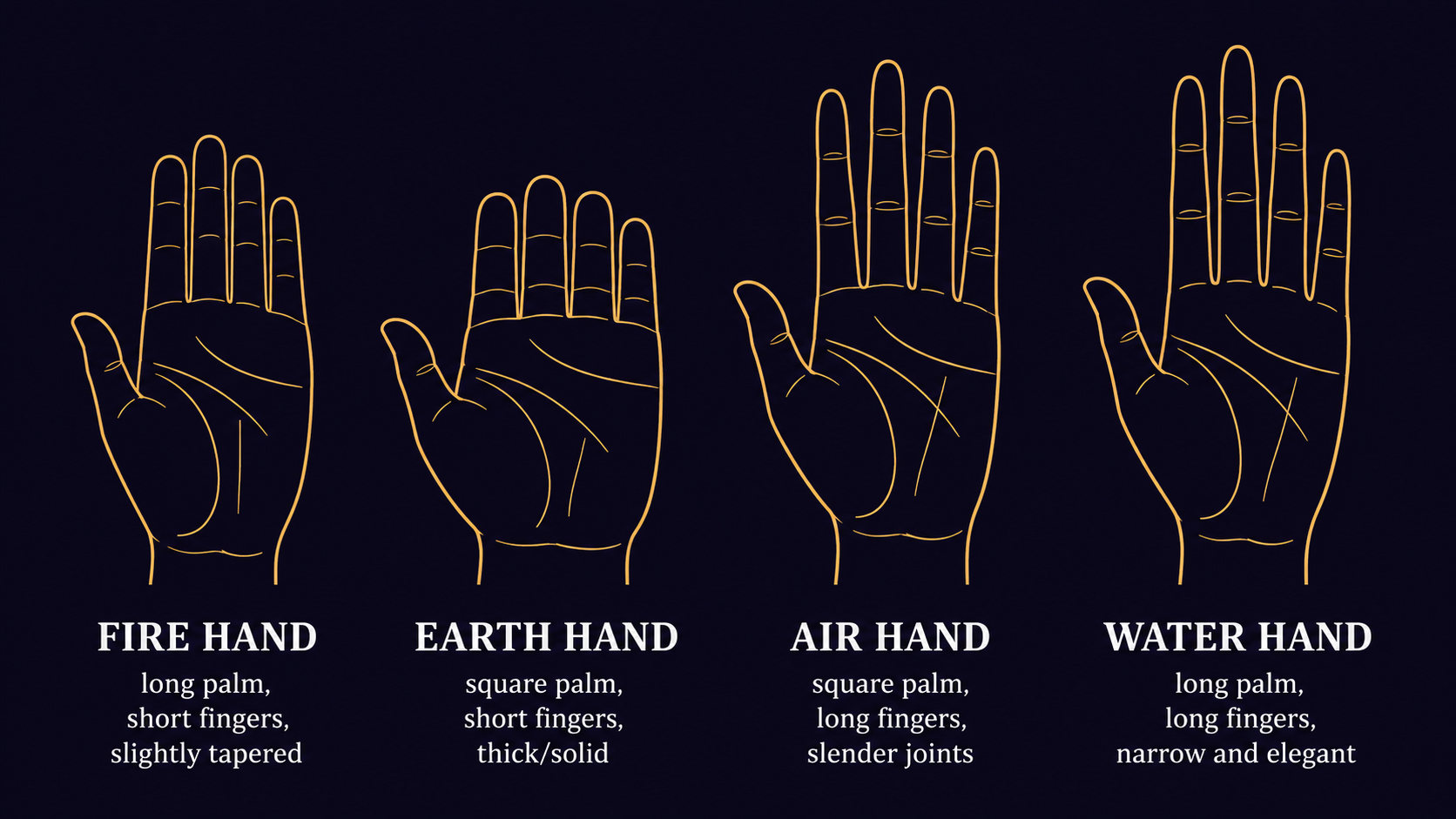
| Hand Type | Shape | Typical Personality |
|---|---|---|
| Fire Hand | Rectangular palm, short fingers | Energetic, impulsive, natural leaders. High drive, low patience. |
| Earth Hand | Square palm, short fingers | Practical, grounded, reliable. Prefers routine over novelty. |
| Air Hand | Square palm, long fingers | Intellectual, communicative, analytical. Lives in ideas more than feelings. |
| Water Hand | Long palm, long fingers | Sensitive, creative, intuitive. Absorbs emotions from surroundings. |
When you classify a hand, look at palm shape first, then finger length relative to the palm. A square palm with long fingers is Air, not Earth. The fingers are the deciding factor when palm shape alone is ambiguous.
The Palm Reading Chart: All Lines at a Glance
This chart shows every significant line on the palm, from the four major lines that every reader must know, down to the minor lines that add nuance once you're comfortable with the basics.
The Three Major Lines
These three lines appear on virtually every hand. Read them in this order: Head Line → Life Line → Heart Line.
Head Line (智慧线)
Runs horizontally across the middle of the palm. Represents intellect, thinking style, and decision-making.
- Straight across: Practical, logical, business-minded.
- Sloping toward Moon mount: Creative, imaginative, sometimes melancholic.
- Forked at end ("writer's fork"): Can hold both practical and creative perspectives.
- Joined to Life Line at start: Cautious, sensitive, thoughtful.
- Separated from Life Line: Independent, decisive, sometimes reckless.
- Chained or with islands: Mental fatigue, anxiety, periods of overload.
Life Line (生命线)
Arcs around the base of the thumb. Represents vitality, health resilience, and major life changes.
⚠️ The most common myth: A short Life Line does NOT mean a short life. Length correlates with energy and recovery ability, not lifespan.
- Deep and clear: Strong constitution, good resilience.
- Wide and shallow: Appears healthy but lower stress tolerance.
- Chained: Childhood frailty, often outgrown.
- Branches rising: Upward ambition. Branches falling: Energy drain.
- Broken: Major life change at that point — not necessarily negative.
Heart Line (感情线)
Runs across the upper palm beneath the fingers. Represents emotional nature, relationship patterns, and cardiac health.
- Starting under Jupiter (index finger): Idealistic, loyal, "one person for life" type.
- Starting between Jupiter and Saturn: Balanced, the most common position.
- Starting from Saturn (middle finger): More self-interested in love, realistic.
- Chained with many branches: Affectionate but restless, many short connections.
- Ruler-straight, no branches: Reserved, hard to read emotionally.
- Merged with Head Line (Simian line): Rare, intense, single-minded — both gift and risk.
The Minor Lines
These lines are not always present. When they appear, they add important detail.
Fate Line (命运线)
Vertical line running from the wrist toward the middle finger. Represents career direction and life path.
- Straight from wrist: Strong sense of direction, classic "driven" life.
- Starting from Moon mount: Career shaped by others (partners, mentors, public).
- Starting from Life line: Self-made, often after early constraints.
- Faint or absent: Not a bad sign — many successful people lack a strong Fate Line. Means life has been less linear.
Sun Line / Apollo Line (太阳线)
Parallel to the Fate Line, running toward the ring finger. Represents creativity, reputation, and recognition.
- Strong and clear: Natural talent that gets noticed.
- Starting from Heart Line: Late-blooming success, recognition after emotional maturity.
- Starting from wrist: Creative from early life.
- Islands or breaks: Periods of creative block or lost reputation.
Mercury Line / Health Line (水星线/健康线)
Running from the palm's center toward the Mercury mount (pinky). Represents health and business sense.
- Clear and strong: Good health, strong business instincts.
- Chained or broken: Health concerns, need for lifestyle changes.
- Absent: Not a health concern — just means health isn't a major theme.
Marriage Lines (婚姻线)
Short horizontal lines on the edge of the palm below the pinky. Represent significant relationships.
- One deep line: One major relationship dominates.
- Multiple lines: Several significant connections.
- Curving upward: Unhappy with partner. Curving downward: Partner brings negativity.
- Length and depth indicate the intensity, not necessarily the duration.
Special Symbols
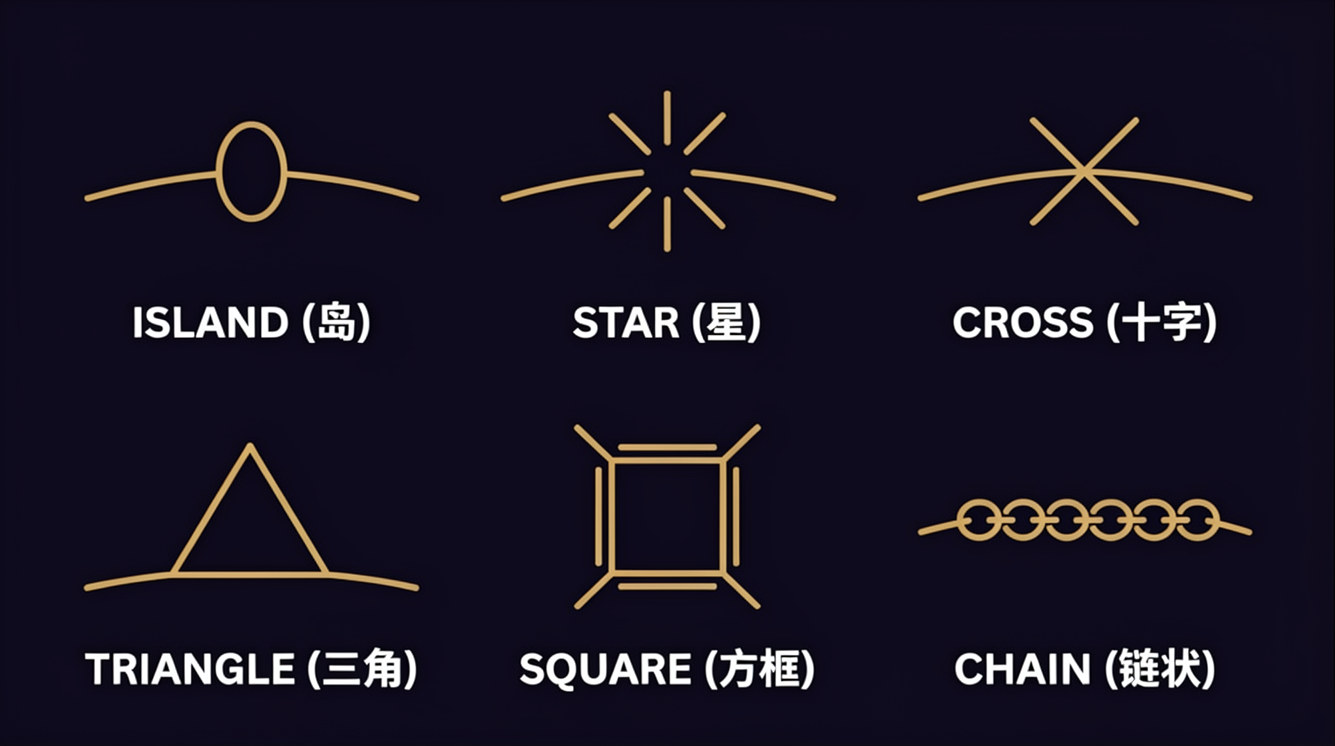
These marks appear on or across lines and modify their meaning.
| Symbol | Meaning | Location Notes |
|---|---|---|
| Star (★) | Sudden event — dramatic, good or bad | On Jupiter mount: ambition fulfilled. On Heart Line: emotional crisis. |
| Cross (+) | Obstacle or warning | Between Head and Heart lines: "Mystic Cross" — interest in the unseen. |
| Square (□) | Protection — the most welcome sign | Surrounds and protects a damaged line section. |
| Island (⬭) | Weakening of the line's meaning | On Head Line: mental fatigue. On Life Line: health dip. |
| Triangle (△) | Ability or success in that area | On mounts: natural talent. On lines: skill applied well. |
| Chain (⛓) | Slow, draining period | Throughout a line section: prolonged difficulty. |
| Grille (⊞) | Scattered energy | On a mount: drive is dispersed, hard to focus. |
| Dot (•) | Acute event at that point | On any line: a specific incident worth noting. |
The Seven Mounts
The mounts are the fleshy pads at the base of each finger and along the palm's edges. The most prominent mount reveals what a person instinctively reaches for.
| Mount | Location | Represents |
|---|---|---|
| Jupiter | Base of index finger | Ambition, leadership, ego |
| Saturn | Base of middle finger | Discipline, seriousness, wisdom |
| Sun / Apollo | Base of ring finger | Art, recognition, charm |
| Mercury | Base of pinky | Communication, commerce, quickness |
| Mars | Two zones: upper (thumb side) and lower (pinky side) | Courage, endurance, fight |
| Moon | Heel of palm, opposite thumb | Imagination, intuition, restlessness |
| Venus | Base of thumb, large pad | Love, vitality, sensual energy |
Reading mounts: A flat mount means that drive is quiet. An overdeveloped mount means that drive dominates. Neither is "good" or "bad" — it's temperament.
How to Use This Chart in Practice
When you sit down to read a hand, follow this sequence:
- Classify the hand type (Fire, Earth, Air, Water).
- Read the Head Line first — it's the compass for everything else.
- Follow with the Life Line — check vitality and resilience.
- Then the Heart Line — emotional patterns and relationship style.
- Check the Fate Line — direction and career patterns.
- Look at minor lines — only after the majors are clear.
- Note any symbols — they modify whatever they touch.
- Check mounts — see which drive is strongest.
- Date events cautiously — trust 1–2 year windows, not decade predictions.
Reading Order Summary
| Order | Element | What It Tells You |
|---|---|---|
| 1 | Hand Type | Temperament baseline |
| 2 | Head Line | How they think |
| 3 | Life Line | Vitality and resilience |
| 4 | Heart Line | How they love |
| 5 | Fate Line | Direction in life |
| 6 | Minor Lines | Nuance and detail |
| 7 | Symbols | Events and modifications |
| 8 | Mounts | Core drives |
Interactive Palm Reading Chart
Below is an interactive version of this chart. Hover over any line to see its name and meaning. Click for detailed reading instructions.
Interactive palm chart coming soon — currently being built with SVG.
Frequently Asked Questions
What is a palm reading chart? A palm reading chart is a reference diagram that maps all the lines, mounts, and symbols found on the human palm, along with their traditional meanings. It serves as a quick-reference guide for both beginners and experienced palm readers.
Which line is most important in palm reading? The Head Line is considered the most important because it reveals thinking style and decision-making ability. A strong Head Line can compensate for weaknesses elsewhere. However, a complete reading always considers all lines together as a system.
Does a short life line mean a short life? No. This is the most persistent myth in palmistry. The Life Line's length correlates with vitality and resilience — how easily you bounce back from illness — not with how many years you will live. Many people with short Life Lines live into their 90s.
Can palm lines change over time? Yes. Major lines are mostly stable, but minor lines, branches, and especially the Fate Line can deepen, fade, or fork over years. This is why palm reading is a snapshot of the present, not a fixed destiny.
What do the mounts on the palm represent? The seven mounts represent different drives and personality traits: Jupiter (ambition), Saturn (discipline), Sun (creativity), Mercury (communication), Mars (courage), Moon (imagination), and Venus (love). The most prominent mount shows what you instinctively reach for.
How accurate is palm reading? For describing temperament, drives, and current state — surprisingly accurate when done carefully. For predicting specific future events — unreliable beyond 1–2 years. Treat palm reading as character analysis with a short forecast window, not fortune-telling.
Is palmistry a science? No. Palmistry is a traditional system of pattern recognition based on hand anatomy, gesture, and surface markings. Some patterns overlap with medical signals (nail health, hand temperature), but most of the system is psychology and observation under another name.
Sources and Further Reading
This chart draws from classical Western palmistry traditions, primarily:
- Cheiro (William John Warner). Palmistry for All. G.P. Putnam's Sons, 1916. — The foundational text of modern Western palmistry. Now in the public domain via Project Gutenberg.
- Mrs. J.B. Dale. Indian Palmistry. 1895. — A comparative Eastern perspective on hand analysis.
- Noel Jaquin. The Royal Road to Cheiromancy. 1932. — A more scientific approach to classical palm reading.
For a step-by-step practical guide, see How to Read Palms: A 9-Step Guide.
Image credits. Hand type illustration, palm symbols chart, and cover image are original works created for this site. Classical illustrations (where used) are from Cheiro's Palmistry for All (1916, public domain).
How to Read Palms: A Practical 9-Step Guide for Beginners
A first-hand walkthrough of palm reading — hand shape, thumb, mounts, the four major lines, and the mistakes most beginners make in their first month.
Palm Reading Symbols: What Stars, Triangles, Crosses & Every Mark Mean
A complete guide to palm reading symbols — stars, triangles, crosses, squares, islands, chains, grilles, and dots. Learn what each mark means and how to read them on any line.