
Head Line Palm Reading: Where It Sits and What Each Pattern Means
A practical guide to head line palm reading — where the head line sits, how its length, curve, and ending point change the meaning, and what each classical pattern tells you about how someone thinks.
What does the head line tell you, and how do you read it? Hold your hand flat, palm up, and find the horizontal line running across the middle of your palm — that is the head line (sometimes called the wisdom line). It describes how a person thinks: whether they reason logically or intuitively, how well they concentrate, what kind of problems attract their mind, and whether their decisions are driven more by analysis or imagination. It does not predict how intelligent someone is.
This guide describes the Cheiro / Indian-tradition reading of the head line, treats it as a thinking-style marker rather than a prediction, and is honest about the limits — the same tone as the 9-step palm reading guide and the heart line guide. If you finish this page, you will know how the head line's ending point, curve, length, and markings each change the reading, and where the tradition genuinely overreaches.
What Is the Head Line in Palm Reading?
The head line is the middle of the three major lines — below the heart line, which sits closest to the fingers, and above the life line, which curves around the thumb. It runs roughly horizontally across the center of the palm.
Where the heart line records how someone feels, the head line records how they think — the intellectual style underneath every decision. Cheiro treats it in Palmistry for All (1916) as the line that governs "the mentality and the quality of the brain." The classical Indian tradition, as described in Indian Palmistry (1895), similarly positions it as the line of wisdom — the clearest single read of reasoning style on the hand. But it is only ever one piece: the heart line above it describes how someone feels, and the life line below it adds vitality and physical energy. All three must be read together.
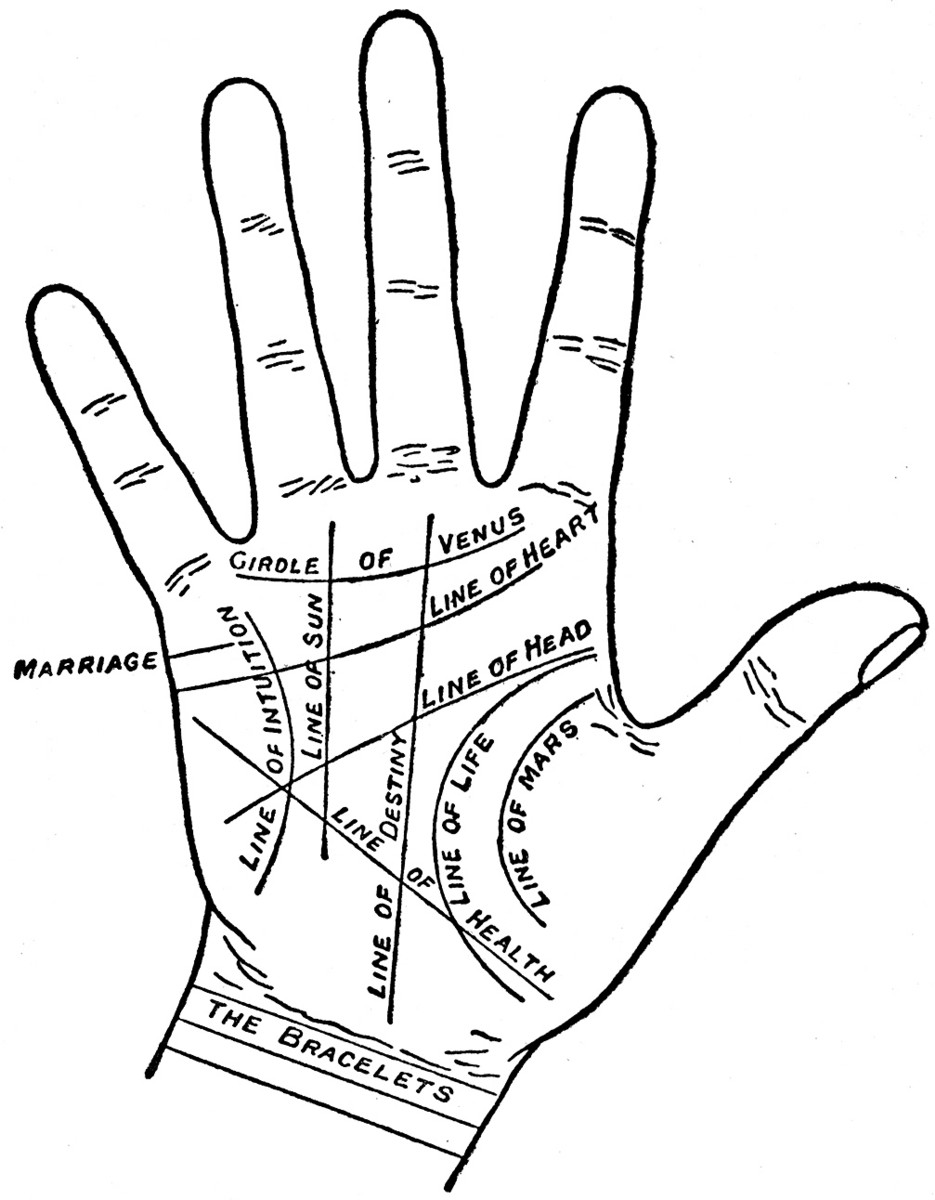
The classic palmistry overview from Cheiro's Palmistry for All (1916, public domain). The head line is the middle horizontal line, sitting between the heart line above and the life line below.
Where the Head Line Sits on Your Hand
Hold your hand flat, palm up. The head line is the middle horizontal line on the palm — the one between the heart line above it and the life line below it. The heart line is closest to your fingers; the life line curves around the base of your thumb; and the head line runs between them.
The line usually starts near the percussion edge (the side of the hand under the index finger) and travels across the palm toward the outer edge. In many hands, the beginning of the head line overlaps or connects with the beginning of the life line — that junction is one of the most read features on the hand and is covered in detail below.
Which Direction to Read the Head Line
Cheiro and the classical tradition read the head line from the percussion edge toward the fingers — meaning the line ends under the outer fingers, and where it ends is the part you interpret. Many modern palmists describe it the opposite way, calling the finger-side the "start."
The terminology does not matter; the finger-side terminus is the meaningful feature either way. To avoid confusion, this guide always refers to "where the head line ends toward the outer palm." That ending point is the single most informative thing about the line.
Where the Head Line Ends: The Most Important Feature
The point toward the outer palm where the head line terminates sets the basic thinking style. The four classical endings, moving across the palm:
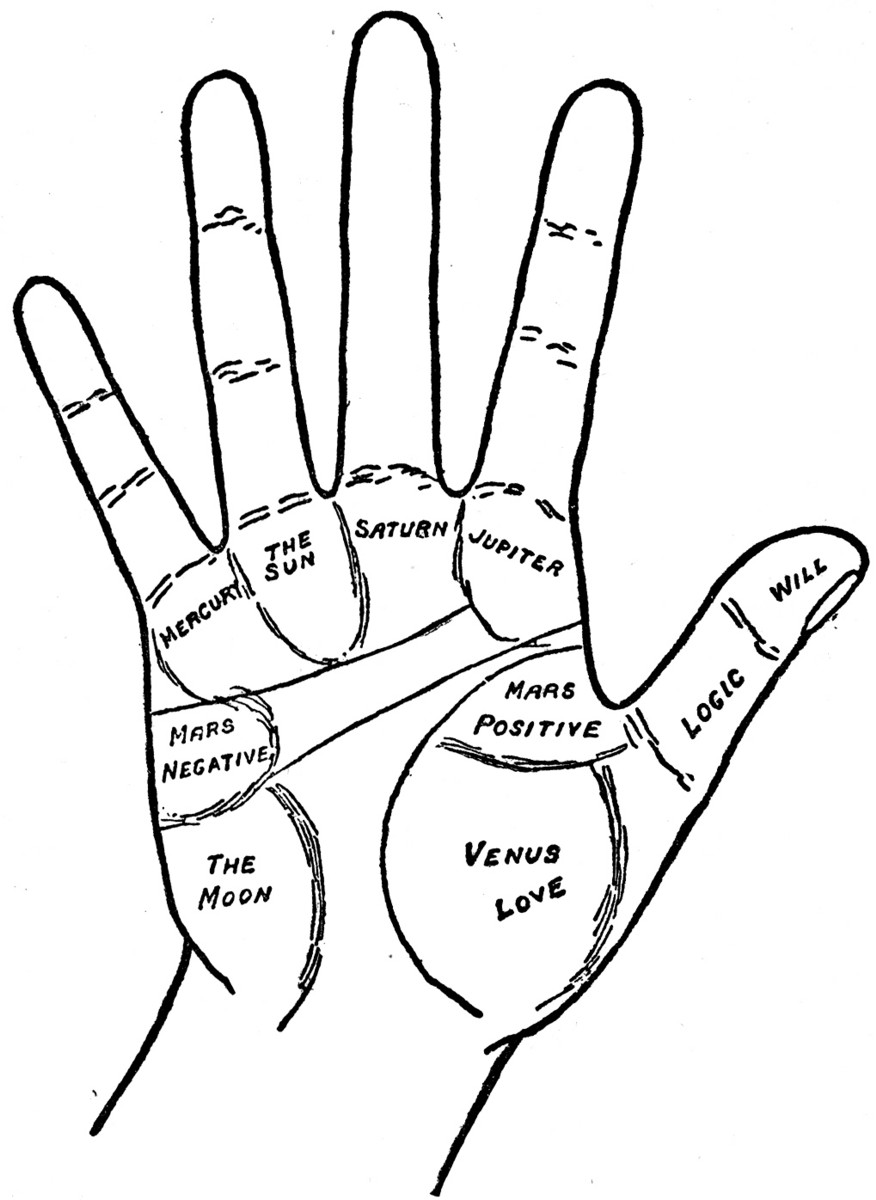
The seven mounts (Cheiro, 1916). The head line's ending position — under Jupiter (index), Saturn (middle), or toward Mercury (pinky) — changes its meaning most.
Ending under the Jupiter (index) finger
This is the creative, imaginative ending. The head line curves upward toward the Jupiter mount, marking someone whose thinking is shaped by vision, idealism, and imagination. They think in pictures and possibilities, often excelling in creative fields, writing, or any work that rewards a strong inner vision. At its best this is visionary; at its worst it is impractical and disconnected from facts.
Ending between the Jupiter and Saturn fingers
This is the practical, balanced ending — the most common and, classically, the easiest thinking temperament. It blends imagination with realism: the person can brainstorm ideas and also evaluate which ones work. Most well-functioning head lines land here.
Ending under the Saturn (middle) finger
This is the analytical, detail-oriented ending. The head line runs straight toward the Saturn mount, marking someone who thinks in facts, sequences, and evidence. They are methodical, careful, and often excel in research, accounting, engineering, or any field where precision matters. A very straight head line ending under Saturn with no curve at all can indicate rigidity — strong analysis but difficulty with creative leaps.
Ending toward the Mercury (pinky) finger
This is the scientific, business-minded ending. The head line stretches far across the palm toward the Mercury mount, marking someone with sharp commercial or scientific instincts. They think strategically, spot patterns others miss, and are often drawn to business, medicine, or the sciences. Cheiro notes this ending frequently on the hands of successful merchants and physicians.
Curved vs Straight: The Two Basic Head Line Types
After the ending point, the shape of the line is the next thing to read. There are two basic types, and most hands lean clearly toward one.
Curved head line (sloping downward toward the wrist): the creative, intuitive type. These people think in images, feelings, and associations rather than in linear logic. They are imaginative, often artistic, and tend to solve problems by feel rather than by method. The deeper the downward slope, the more emotionally and creatively oriented the thinking. Cheiro associates the curved line with the "imaginative" mind.
Straight head line (running flat across the palm): the logical, practical type. These people think in facts, sequences, and evidence. They are methodical, direct, and often excel at structured, rule-based work. A very straight head line with no curve at all can sometimes indicate stubbornness — strong reasoning but limited flexibility.
Neither type is better. A curved head line with a weak heart line can be impractical in relationships; a straight head line with a strong heart line is often the most reliable decision-maker on the page. The curve tells you the style of thinking, not the quality.
Head Line Length and Depth
Length. A long head line stretching well across the palm marks a broad thinker — someone with wide-ranging intellectual interests, who reads widely and connects ideas across fields. The longer the line, the more varied the mental appetite. A short head line marks a focused, specialized thinker who goes deep into one subject rather than sampling many. Short is not "less intelligent"; it is "concentrated." These people often excel in technical or craft-based fields where depth matters more than breadth.
Depth. A deep, clearly cut head line marks strong concentration — the ability to focus intently on a single problem for extended periods. A faint or shallow line marks lighter, more scattered thinking — many interests, difficulty sustaining focus on one thing. A broad, shallow line often reads as someone whose mind ranges widely but does not dig deep in any one area.
The Head Line Patterns Worth Knowing
Beyond ending point, curve, and length, a handful of markings come up repeatedly. For each I give the classical reading and an honest note on where it gets over-read.
A forked end
A head line that forks at the outer end is one of the best patterns to have. The classic two-pronged fork — sometimes called the writer's fork or, in medical palmistry, the medical stigmata — blends creative imagination with analytical precision: someone who can both generate ideas and evaluate them. A three-pronged fork is rarer and adds diplomatic or communicative skill. A downward fork dipping toward the life line reads as imagination pulled toward practical caution.
Branches rising upward
Small lines branching upward off the head line are classically read as optimistic thinking, intellectual ambition, or positive mental breakthroughs. A cluster of fine upward branches marks someone whose mind naturally tends toward solutions rather than problems.
Branches dropping downward
Lines branching downward off the head line read as worry, disappointment, or periods of mental fatigue. One or two fine downward branches are normal; a cluster of many may mark someone prone to overthinking or anxiety. In practice I treat a cluster of downward branches as a temperament marker — a mind that tends to rehearse problems — rather than as a list of specific bad events.
A chained or wavy line
A chained head line (made of little linked loops) or a wavy one reads as indecision and overthinking — frequent second-guessing, difficulty committing to a course of action, and a mind that circles problems rather than resolving them. This describes a thinking style, not a fixed limitation. Many people with chained head lines learn, over time, to work with their deliberative nature rather than against it.
A broken line
A clear break in the head line is the classical sign of a sudden change in thinking — a career shift, a change of belief system, or a mental crisis that reoriented how someone reasons. If the two segments overlap, the reading is a gradual transition; a clean gap reads as a more abrupt break. I only treat a break as significant when another part of the hand — the fate line, for instance — confirms the same story.
An island on the line
An island — a small oval loop in the line — marks a period of mental stress, confusion, or indecision. The classical reading treats it as temporary: the island opens and closes, and after it the line resumes. Islands near the start of the head line often relate to early-life learning difficulties or family pressure; islands in the middle relate to adult stress periods. The larger the island, the longer the difficult period.
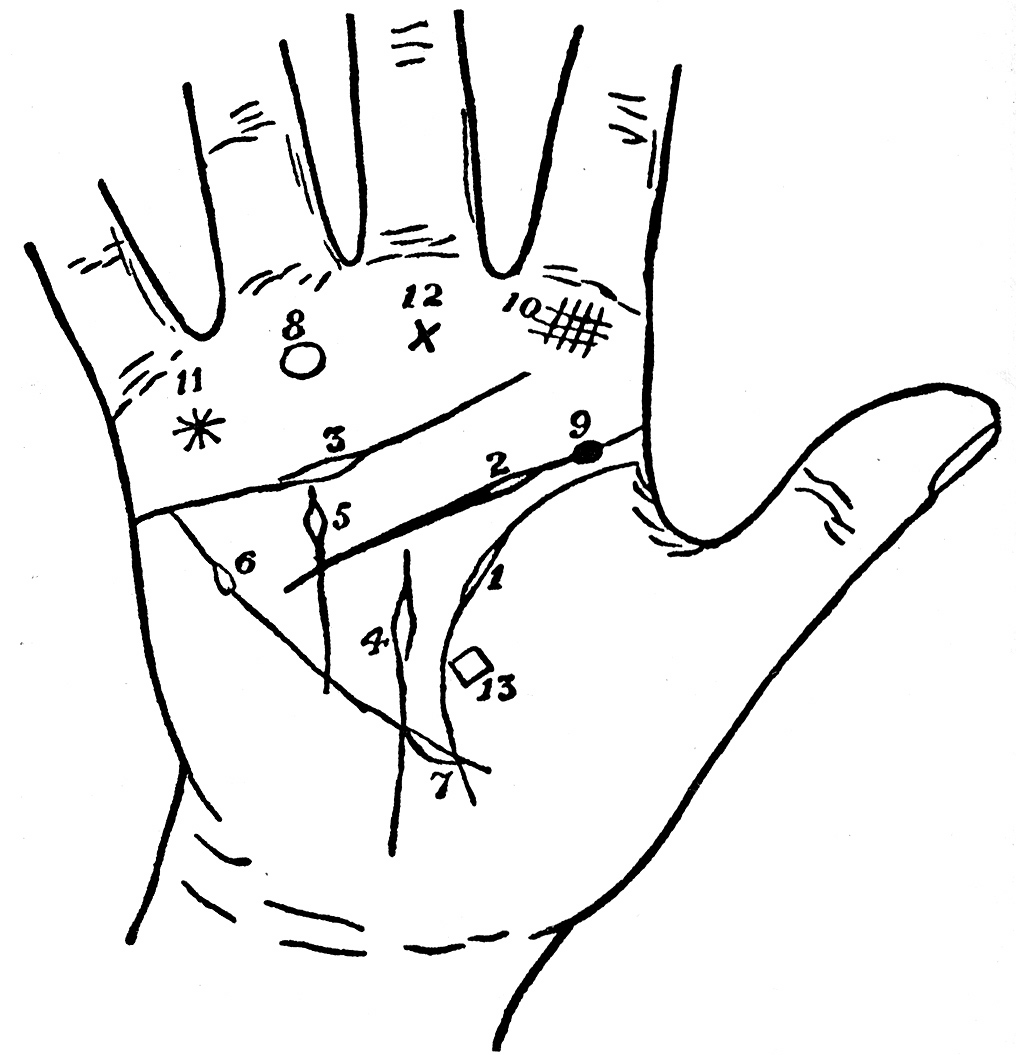
Cheiro Plate XXII — the six classical marks (island, circle, spot, grille, star, square) that can appear on the head line and modify its meaning.
Circles, stars, and squares
A circle on the head line classically marks a loss or setback in the area of thinking the line segment covers — but circles are rare on the head line and often misread as whorls in the skin. A star marks a sudden burst of brilliance or a crisis that became a breakthrough. A square is a protective mark — classical palmistry reads it as a period of difficulty that was contained and resolved without lasting damage. Treat all of these as secondary to the line's basic shape and ending, and only read them when they are clearly defined.
Head Line Connected to Life Line
Where the head line and life line begin is one of the most read features on the hand. The three classical patterns:
Connected at the start: The head line and life line share a common beginning. The longer the connection, the more cautious and family-influenced the thinking. These people were shaped strongly by early upbringing, tend toward careful deliberation, and often seek approval before making decisions. Cheiro reads a long connection as someone who "does not act without first consulting others."
Separated early: The head line and life line start apart, with a visible gap between them. This marks independence and risk-taking from an early age — someone who thinks for themselves, acts on their own judgment, and is comfortable with uncertainty. The wider the gap, the more fiercely independent the temperament.
Overlapping start: In some hands the lines overlap briefly before separating. This is the most cautious of the three — a very careful, deliberate start to life, often someone who was sheltered or held back early on and then found their stride later.
Head Line and Heart Line Relationship
The distance between the head line and the heart line matters. In most hands there is a clear gap between them, and the size of that gap is telling:
- Wide gap: an open, independent nature — comfortable acting on its own terms, sometimes blunt, not easily swayed by others' feelings.
- Narrow gap: a more cautious, tightly controlled temperament where thinking and feeling stay closely coupled. These people tend to second-guess decisions through both an emotional and intellectual lens before acting.
- Merged (simian line): in some hands the heart line and head line fuse into a single crease running straight across the palm. This is the simian line — see the heart line guide for a full description. Classically it marks an intense, all-or-nothing temperament that fuses emotion and logic into one drive.
Head Line and Fate Line
The fate line — the vertical line running up the center of the palm toward the middle finger — intersects the head line in many hands. When it does, the classical reading is that career is shaped by intellect: the person's professional direction is driven by their thinking ability, education, or analytical skill rather than by passion (heart line) or physical energy (life line).
If the fate line starts at the head line rather than lower in the palm, the classical reading is a late-blooming career — one that begins after a period of education or intellectual development, often in the late twenties or thirties. If the fate line stops at the head line and does not continue above it, the reading is a career that was interrupted or redirected by a change in thinking.
For a full treatment of the fate line's own patterns, see the fate line guide.
Reading the Head Line on Both Hands
The dominant / non-dominant rule from the main palm reading guide applies cleanly. The dominant (writing) hand shows your present-day thinking style and intellectual habits; the non-dominant hand shows the mental temperament you inherited. When both hands carry a similar head line, the reading is strong and stable. When they disagree — say, a straight analytical line on one hand and a curved creative line on the other — the person is usually consciously reshaping how they think, either developing new reasoning habits or moving away from an inherited style.
Limits: What the Head Line Cannot Tell You
To match the honest-tradeoff tone of the rest of this site, here is what the head line cannot reliably tell you:
- Your IQ or intelligence level. The head line describes thinking style — creative vs. logical, broad vs. focused — not thinking capacity. A short head line does not mean less intelligent; a long one does not mean genius.
- Your specific career. A scientific ending does not mean you will be a scientist; a creative ending does not mean you will be an artist. The line describes the kind of thinking that comes naturally, not the job title that follows.
- A medical or mental-health diagnosis. An island, a chained line, or a break is a temperament marker, not a clinical finding, and must never be read as one. Classical palmistry predates modern psychology; its categories are descriptive, not diagnostic.
- Your future. The head line describes how you think now and how you have thought in the past. It does not predict events, outcomes, or life changes — though a break in the line may mark a change that has already happened or is in progress.
What the head line can describe is the texture of how someone reasons: imaginative or analytical, focused or scattered, cautious or independent, steady or changeable. Read at that level, it is one of the most useful lines on the hand. Read past it, you are guessing.
Frequently Asked Questions
What does the head line mean in palm reading?
The head line is the middle of the three major lines, running horizontally across the center of the palm between the heart line above and the life line below. It describes how a person thinks — concentration, reasoning style, intellectual interests, and decision-making habits — rather than how intelligent they are. It is read alongside the heart line and life line, never in isolation.
Where exactly is the head line on the hand?
Hold your hand flat, palm up. The head line is the middle horizontal line, sitting between the heart line above it and the life line below it. It usually starts near the percussion edge (the side under the index finger) and runs across the center of the palm toward the outer edge. If you can find the three major lines, the one in the middle is the head line.
What does a curved head line mean?
A head line that curves downward toward the wrist belongs to the creative, intuitive, imaginative type — someone who thinks in images and feelings rather than pure logic. The deeper the curve, the more emotionally and artistically oriented the thinking style. Cheiro calls this the "imaginative" head line in Palmistry for All (1916).
What does a straight head line mean?
A head line that runs flat and straight across the palm belongs to the logical, practical, analytical type — someone who thinks in facts, sequences, and evidence. They are methodical, direct, and often excel at structured work. A very straight head line with no curve at all can sometimes indicate rigidity in thinking.
What does a long head line mean?
A long head line that stretches well across the palm marks a broad thinker — someone with wide-ranging intellectual interests, who reads widely and connects ideas across different fields. The longer the line, the more varied the mental appetite. A very long head line reaching toward the percussion edge can indicate someone whose thinking never really switches off.
What does a short head line mean?
A short head line marks a focused, specialized thinker — someone who goes deep into one subject rather than sampling many. Short is not "less intelligent"; it is "concentrated." These people often excel in technical or craft-based fields where depth matters more than breadth.
What does a forked head line mean?
A fork at the end of the head line is one of the best patterns to find. A two-pronged fork — sometimes called the writer's fork — blends creative imagination with analytical precision: someone who can both brainstorm and execute. A three-pronged fork is rarer and adds diplomatic skill to the mix. A downward fork dipping toward the life line reads as imagination pulled toward practical caution.
What does a broken head line mean?
A break in the head line is the classical sign of a sudden change in thinking — a career shift, a change of belief system, or a period of mental crisis that reoriented how someone reasons. If the two segments overlap it usually means a gradual transition; a clean gap reads as a more abrupt break. Only treat it as significant when other markings on the hand support the same story.
What does an island on the head line mean?
An island — a small oval loop in the line — marks a period of mental stress, confusion, or indecision. The classical reading treats it as temporary: the island opens and closes, and after it the line resumes. Islands near the start of the head line often relate to early-life learning difficulties or family pressure; islands in the middle relate to adult stress periods.
What does it mean when the head line is connected to the life line?
When the head line and life line are joined at the starting point, the classical reading is a cautious, family-influenced thinker — someone whose decisions are shaped by early upbringing and who tends toward careful deliberation. The longer the connection, the more cautious the start. A separated start reads as independence and risk-taking from an early age.
Which hand should I read for the head line?
Read the dominant — writing — hand for your present-day thinking style and intellectual habits. Read the non-dominant hand for your inherited mental temperament. If the two disagree, the person is usually consciously reshaping how they think — perhaps moving from a cautious inherited style to a more independent one, or vice versa.
Is the head line the same as the wisdom line?
Yes — wisdom line is a popular nickname for the head line, especially in Indian palmistry traditions. Classical Western texts like Cheiro's Palmistry for All (1916) call it the head line or line of head. Some Indian texts use "line of wisdom" or "buddhi rekha." All refer to the same horizontal line across the center of the palm.
Where to Go Next
If you want the full framework — hand shape, thumb, mounts, all four major lines, the dating method, and the mistakes most beginners make — read the 9-step palm reading guide. The head line is one piece of a larger reading, and the heart line directly above it changes its meaning more than any single marking does.
For the emotional side — how someone loves and shows affection — see the heart line guide. The head line tells you how someone thinks; the heart line tells you how they feel. The two are always read together.
For the career and reputation side — how you are recognized and what drives your professional path — see the fate line guide. The head line tells you how you reason; the fate line tells you where that reasoning leads.
If you want a structured reading of your own palm in about a minute, scan your hand on the Scan page. It walks through the same classical framework this guide draws from and flags the head-line patterns it finds.
Image credits. All plates on this page are reproduced from Cheiro's Palmistry for All (G.P. Putnam's Sons, 1916), now in the public domain. Scans courtesy of Project Gutenberg.
Fate Line Palm Reading: Where It Sits and What Each Pattern Means
A practical guide to fate line palm reading — where the fate line sits, how its depth, direction, and markings change the meaning, and what each classical pattern actually tells you about career and life direction.
Health Line Palm Reading: Where It Sits and What It Tells You
A practical guide to health line palm reading — where the health line sits, whether you have one, and what classical palmistry actually says about health markers on the hand.