
Fate Line Palm Reading: Where It Sits and What Each Pattern Means
A practical guide to fate line palm reading — where the fate line sits, how its depth, direction, and markings change the meaning, and what each classical pattern actually tells you about career and life direction.
What does the fate line tell you, and how do you read it? Hold your hand flat, palm up, and look for a vertical line running from near the wrist up toward the middle finger — that is the fate line (sometimes called the line of destiny or career line). It describes your career path, external direction, and how much your life is shaped by outside forces versus personal choice. Not everyone has one, and that is perfectly normal.
This guide describes the Cheiro / Indian-tradition reading of the fate line, treats it as a career and life-direction marker rather than a destiny prediction, and is honest about the limits — the same tone as the 9-step palm reading guide and the life line guide. If you finish this page, you will know how the fate line's presence, depth, direction, and markings each change the reading, and where the tradition genuinely overreaches.
What Is the Fate Line in Palm Reading?
The fate line is a vertical line that runs from the wrist area up the center of the palm toward the base of the middle finger (the Saturn mount). It is one of the few major lines that runs vertically rather than horizontally, and it is the line most directly associated with career, external direction, and the forces that shape your life path.
Where the life line records your vitality and personal energy and the heart line records how you love, the fate line records how much your life is directed by external circumstances — a career, a calling, a family expectation, a defining role. Cheiro treats it in Palmistry for All (1916) as the line that governs "the career, the worldly success, and the direction the life will take." It is the line people ask about most when they want to know "what am I meant to do?"
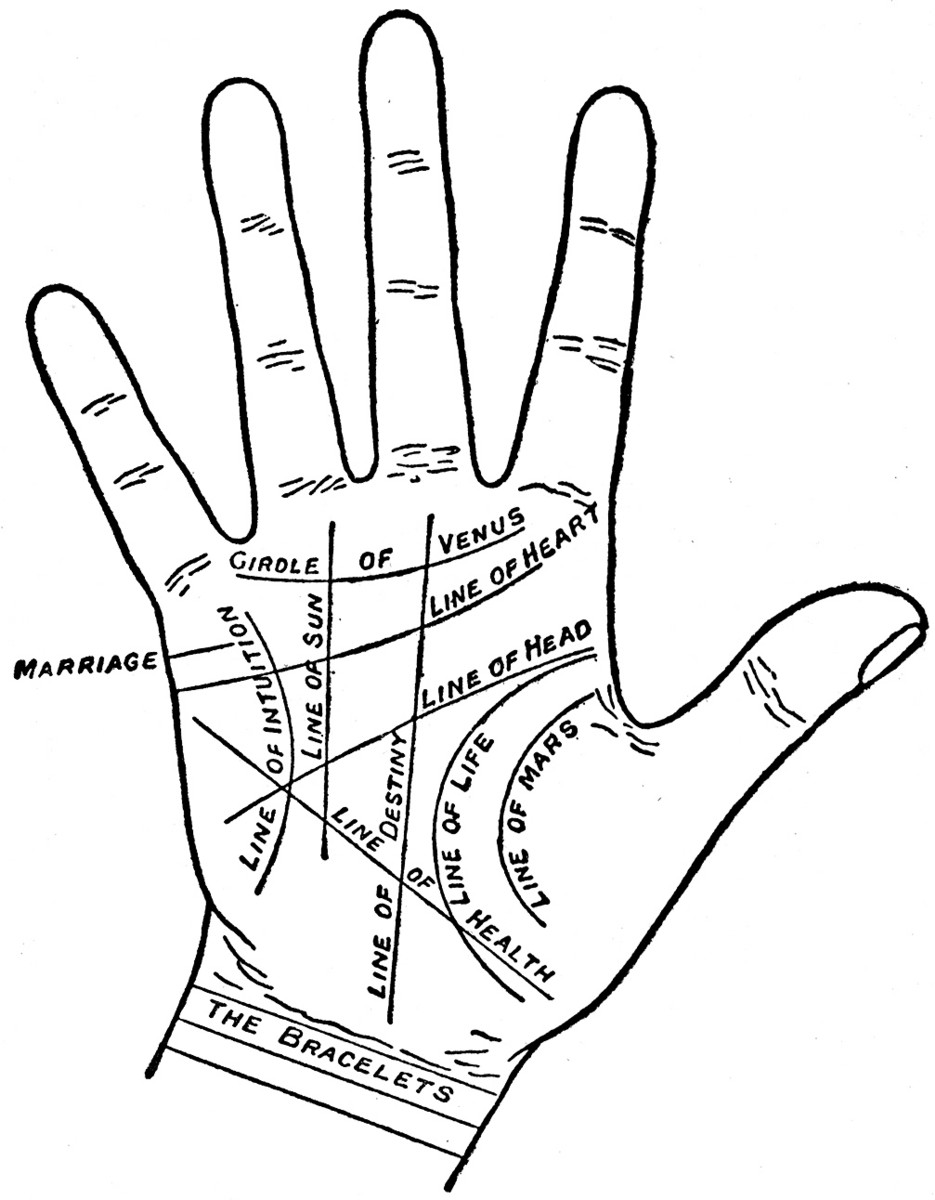
The classic palmistry overview from Cheiro's Palmistry for All (1916, public domain). The fate line runs vertically from the wrist toward the base of the middle finger.
Where the Fate Line Sits on Your Hand
Hold your hand flat, palm up. The fate line, when present, runs vertically from the wrist area up through the center of the palm toward the base of the middle finger. It sits between the life line (which curves around the thumb) and the percussion edge (the outer side of the hand).
Not everyone has a clear fate line. Some people have a deep, well-defined line that runs the full length of the palm. Others have a faint line that only appears in the middle section. And many people have no fate line at all — which is not a problem and does not mean bad luck. It simply marks someone whose life path is more self-determined than externally shaped.
A common beginner mistake is to confuse the fate line with the life line. The life line curves around the thumb; the fate line runs straight up the middle of the palm. They sometimes cross, but they are distinct lines with different meanings.
Which Direction to Read the Fate Line
The fate line is read from the wrist upward toward the fingers. The starting point near the wrist corresponds roughly to early life or the beginning of a career, and the line progresses upward as age advances. Like all palm dating, this is a rough guide — a general age band rather than a precise year.
The depth and clarity of the line at different points along its length tells you about the quality of direction during those life stages. A deep, clear section marks a period of strong career focus and external direction; a faint or broken section marks a period of uncertainty or change.
What Does the Fate Line Mean in Palm Reading?
The fate line describes three things, in order of reliability:
-
Career direction and external influence. A deep, well-defined fate line marks a life strongly shaped by external forces — a clear career path, a defining role, or a destiny that feels predetermined. A faint or absent fate line marks someone whose direction is more self-determined and flexible.
-
Life transitions and turning points. Breaks, forks, and shifts in the fate line's path mark significant career or life transitions — job changes, relocations, periods of crisis and recovery, or moments when external circumstances forced a new direction.
-
The balance between fate and free will. The fate line's relationship to the life line tells you how much of someone's path is self-chosen versus externally imposed. A fate line that starts from the life line marks a career tied to family or early circumstances. A fate line that stands alone marks a more independent path.
What the fate line does not describe is your destiny in a mystical sense. It does not predict whether you will be rich, famous, or happy. It describes the structure of external influence on your life — how much your path is shaped by career, calling, or circumstance rather than personal choice.
Fate Line Depth: Deep vs Faint
Deep fate line. A deep, clearly cut fate line — a groove you can trace easily — marks a life strongly shaped by external forces. These people often have a clear career path, a defining role, or a sense of purpose that feels like it was meant to be. They tend to be driven, focused, and sometimes inflexible about their direction.
Faint fate line. A faint or shallow fate line marks someone whose life direction is more self-determined and flexible. These people may change careers multiple times, explore different paths, or resist being defined by a single role. It is not a weakness — it is a different relationship with direction and purpose.
No fate line. Many people have no fate line at all. This does not mean bad luck or a lack of purpose. It usually marks someone who lives by personal choice rather than external direction — a self-made path. Many entrepreneurs, artists, and independent thinkers have no fate line. Cheiro noted that the absence of a fate line is common on hands that show strong independence and self-reliance.
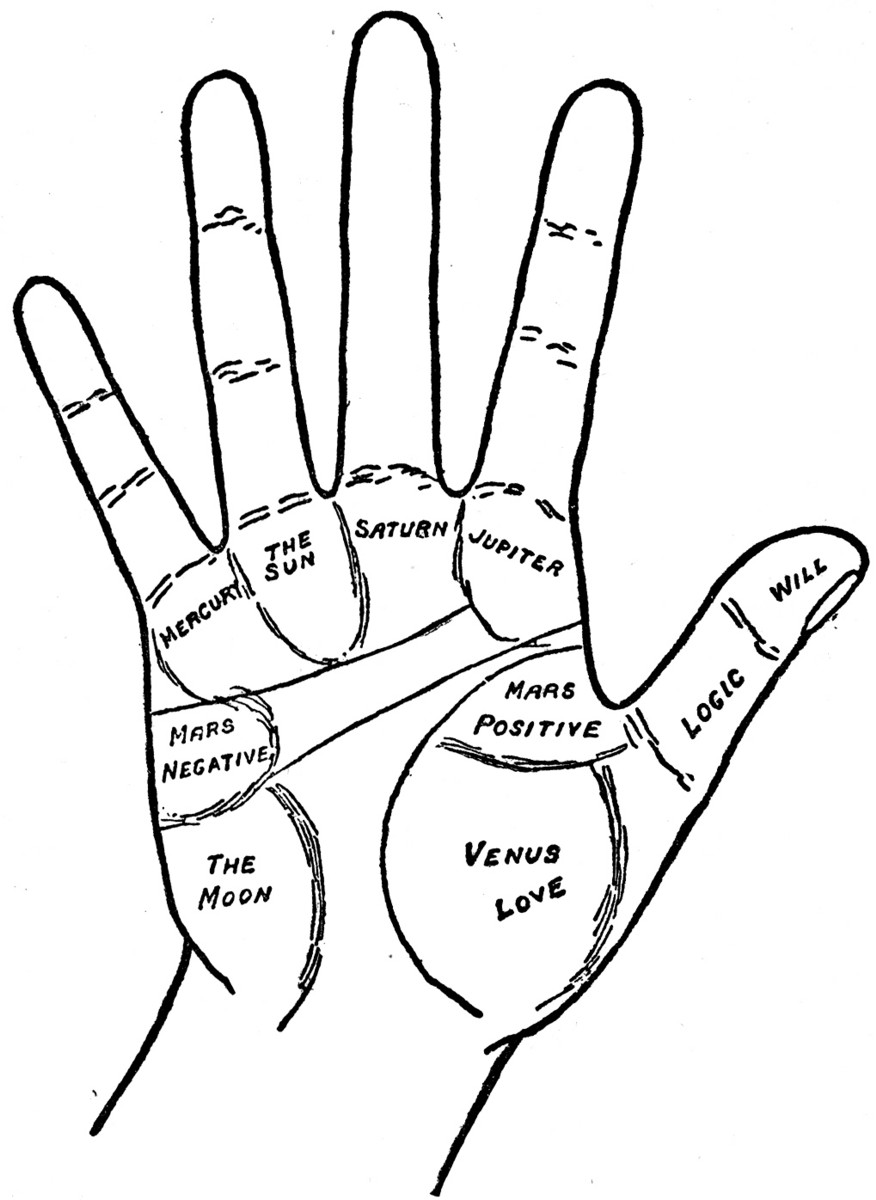
The seven mounts (Cheiro, 1916). The fate line runs toward the Saturn mount under the middle finger — the mount of discipline, focus, and career direction.
Where the Fate Line Starts
Where the fate line begins tells you about the source of direction in someone's life. The three classical starting points:
Starting from the wrist
A fate line that begins clearly at the wrist and runs straight up marks someone whose career direction was set early in life and remained consistent. These people often knew what they wanted from a young age and pursued it with focus. It is the most straightforward reading — a clear, self-directed path.
Starting from the life line
A fate line that begins from or is connected to the life line marks a career closely tied to family, inheritance, or early-life circumstances. The person's path is strongly shaped by their upbringing, a family business, or an expectation set in childhood. It is not a bad thing, but it does mean the path was influenced by others rather than purely self-chosen.
Starting from the center of the palm
A fate line that begins in the middle of the palm — with no clear starting point near the wrist — marks someone whose career direction developed later in life. These people may have spent their early years exploring or drifting before finding their path. The later the start, the later the sense of direction crystallizes.
The Fate Line Patterns Worth Knowing
Beyond starting point and depth, a handful of markings come up repeatedly on the fate line. For each I give the classical reading and an honest note on where it gets over-read.
Broken fate line
A clear break in the fate line is the classical sign of a career disruption or forced redirection — a job loss, a career change, a relocation, or a period when external circumstances knocked the person off their path. If the two segments overlap, the reading is interruption followed by continuation — the person went through a transition but found their way back. A clean gap signals a more dramatic shift — a complete change of direction.
A break that appears on both hands in the same place is more significant than one that appears on only one hand. If only the dominant hand shows a break, the change is likely self-directed; if only the non-dominant hand shows it, the change may have been imposed by circumstances.
Forked fate line
A fork at the end of the fate line, splitting toward the fingers, marks a period of divided interests or a career that branches into two directions. These people often juggle two roles, two careers, or two areas of focus simultaneously. The wider the fork, the more dramatic the split.
A fork at the start of the fate line, near the wrist, reads as a hesitant or dual beginning — two possible paths from early on, a childhood divided between two interests or two places. If the fork is narrow, it is a subtle divergence; if wide, it is a genuine fork in the road.
Curved fate line
A fate line that curves away from its straight vertical path marks a change in career direction or life focus. A curve toward the thumb often means a shift toward more independent or creative work. A curve toward the percussion edge may mean a shift toward more social or public roles.
A fate line that wavers or zigzags — changing direction multiple times — marks a life with many twists and turns. These people often change careers, locations, or priorities several times. It is not instability; it is a life lived in many directions.
Island on the fate line
An island — a small loop in the middle of the fate line — marks a difficult career period, often involving job loss, professional setback, or a loss of direction. The larger the island, the longer or more significant the difficult stretch. Once the island closes and the line continues, the person's career recovers.
Star on the fate line
A star — a small asterisk-like mark on the fate line — is classically read as a sudden stroke of luck or a breakthrough in career. It marks an unexpected opportunity, a promotion, or a moment when circumstances aligned in the person's favor. The honest note: stars are rare and easy to over-interpret. Only treat it as significant if the mark is clear and unambiguous.
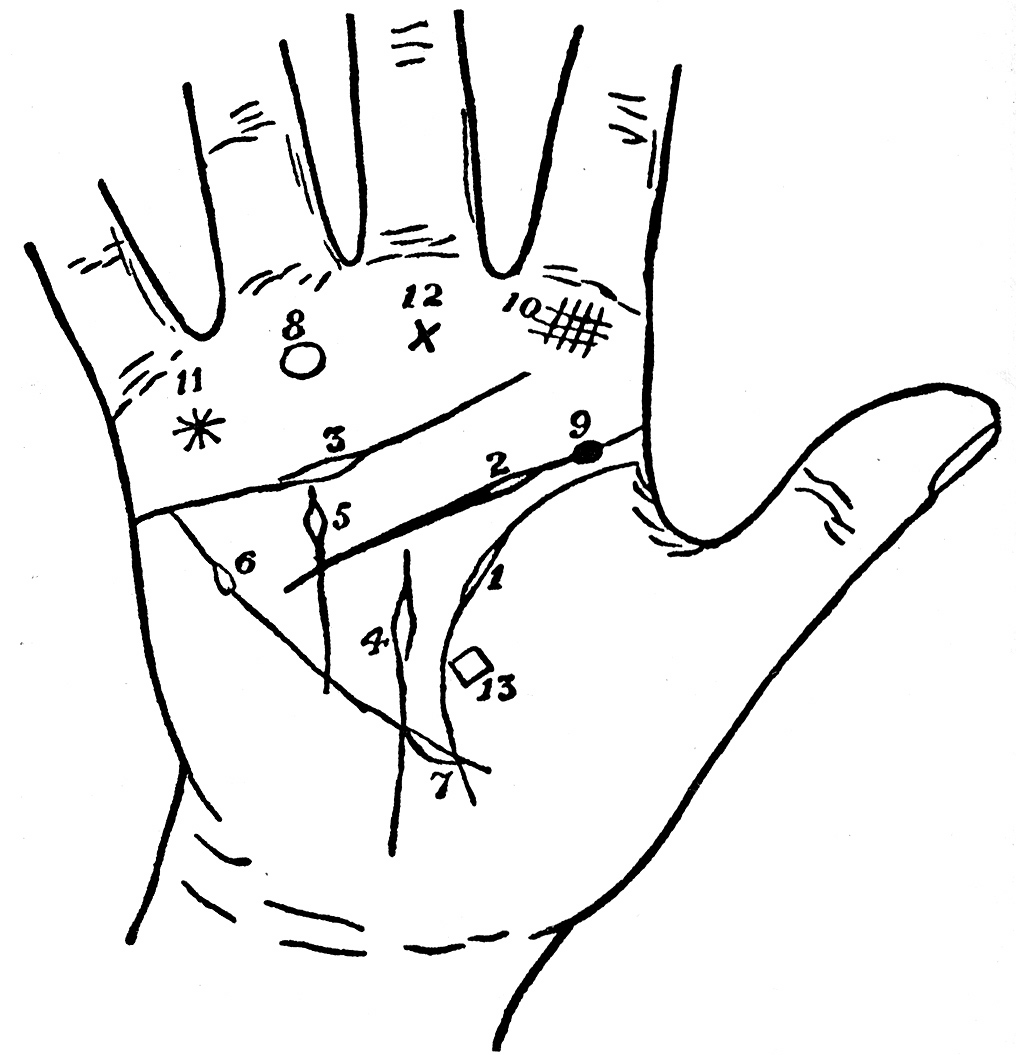
Cheiro Plate XXII — the six classical marks (island, circle, spot, grille, star, square) that can appear on the fate line and modify its meaning.
Fate Line and Life Line Relationship
The relationship between the fate line and the life line is one of the most informative features on the hand. It tells you about the balance between self-direction and external influence.
Fate line touching or crossing the life line
When the fate line touches or crosses the life line, it marks a career closely tied to family, home, or early-life circumstances. The person's path is shaped by their upbringing, a family business, or an expectation set in childhood. The closer the connection, the stronger the family influence.
Fate line separate from the life line
When the fate line runs independently, with a visible gap between it and the life line, it marks a self-directed career path — someone who chose their own direction rather than following a family pattern. The wider the gap, the more independent the path.
Fate line crossing the head line
The fate line often crosses the head line on its way up the palm. The point where it crosses roughly corresponds to the age when the person's career became the dominant force in their life — when work and external direction took over from personal exploration. This is one of the few timing markers on the hand that can be read with some confidence.
Reading the Fate Line on Both Hands
The dominant / non-dominant rule from the main palm reading guide applies cleanly to the fate line. The dominant (writing) hand shows your present-day career and life direction as you are living it now. The non-dominant hand shows the potential or destiny you were born with — the path that was available before you made your choices.
When both hands carry a similar fate line — same depth, same direction, same starting point — the reading is strong and stable. The person is living in alignment with their natural direction. When the two hands disagree sharply — say, a deep fate line on the non-dominant hand but a faint one on the dominant — the person may have departed from their original potential, either by choice or by circumstance.
Limits: What the Fate Line Cannot Tell You
To match the honest-tradeoff tone of the rest of this site, here is what the fate line cannot reliably tell you:
- Whether you will be rich or famous. The fate line describes career direction and external influence, not financial outcome or public recognition. A strong fate line can correlate with a clear career path, but it does not guarantee success.
- What job you should have. The fate line does not name a profession. It describes the structure of direction — how much your path is shaped by external forces versus personal choice — not the specific role you should pursue.
- Your destiny in a mystical sense. The fate line is not a prophecy. It is a marker of career pattern and external influence, read alongside the life line, head line, and mounts. Treating it as a prediction of what "must happen" misreads the tradition.
- When you will get a promotion or find a job. Specific career events are not reliably dated from the fate line. The dating method (tracking the line from wrist to finger across roughly ages 15 to 70) is too imprecise for specific predictions.
What the fate line can describe is the structure of external direction in someone's life: strong or faint, consistent or changing, self-directed or externally shaped. Read at that level, it is one of the most informative lines on the hand for understanding someone's relationship with career and purpose. Read past it, you are guessing.
Frequently Asked Questions
What does the fate line mean in palm reading?
The fate line is a vertical line running from the wrist area up toward the base of the middle finger. It describes your career path, external direction, and how much your life is shaped by outside forces versus personal choice. Not everyone has one, and that is normal.
Where exactly is the fate line on the hand?
The fate line runs vertically from near the wrist, up the center of the palm, toward the base of the middle finger (the Saturn mount). It sits between the life line and the percussion edge. Some people have a very clear fate line; others have a faint one or none at all.
What does it mean if I have no fate line?
No fate line does not mean bad luck. It usually marks someone who lives by personal choice rather than external direction — a self-made path. Many entrepreneurs and independent thinkers have no fate line. It is one of the most misunderstood features in palmistry.
What does a broken fate line mean?
A break in the fate line classically marks a career change, a forced redirection, or a period where external circumstances disrupted your path. If the two segments overlap, it usually means recovery and continuation in a new direction; a clean gap signals a more dramatic shift.
What does a forked fate line mean?
A fork at the end of the fate line, splitting toward the fingers, usually marks a period of divided interests or a career that branches into two directions. A fork at the start, near the wrist, reads as a hesitant or dual beginning — two possible paths from early on.
What does a deep fate line mean?
A deep, clearly cut fate line marks a life strongly shaped by external forces — a clear career path, a defining role, or a destiny that feels predetermined. A faint fate line marks someone whose direction is more self-determined and flexible.
Which hand should I read for the fate line?
Read the dominant — writing — hand for your present-day career and life direction. The non-dominant hand shows the potential or destiny you were born with. If only one hand has a fate line, the reading depends on which hand it is.
Does the fate line predict wealth?
The fate line describes career direction and external influence, not wealth directly. A strong fate line can correlate with a clear career path, which sometimes leads to financial stability, but it is not a money indicator. For wealth markers, palmists look at the money lines and the Mercury mount.
What does a curved fate line mean?
A fate line that curves away from its straight vertical path marks a change in career direction or life focus. A curve toward the thumb often means a shift toward more independent or creative work; a curve toward the percussion edge may mean a shift toward more social or public roles.
Can the fate line change over time?
Yes. The fate line is one of the most changeable lines on the hand. It can deepen, fade, develop breaks, or shift direction as career and life circumstances change. It is reasonable to recheck it every year.
Is the fate line the same as the life line?
No. The fate line runs vertically from the wrist toward the middle finger, relating to career and external direction. The life line curves around the base of the thumb, relating to vitality and life path. They are distinct lines with different meanings.
What does a fate line starting from the life line mean?
A fate line that begins from or is connected to the life line marks a career closely tied to family, inheritance, or early-life circumstances. The person's path is strongly shaped by their upbringing or a family business, rather than being self-chosen from the start.
What does a fate line starting from the wrist mean?
A fate line that begins clearly at the wrist and runs straight up marks someone whose career direction was set early in life and remained consistent. It indicates a strong, focused path — often someone who knew what they wanted from a young age.
Where to Go Next
If you want the full framework — hand shape, thumb, mounts, all four major lines, the dating method, and the mistakes most beginners make — read the 9-step palm reading guide. The fate line is one piece of a larger reading, and the life line it often crosses changes its meaning more than any single marking does.
For the vitality and personal energy side of the hand — how someone lives and what drives them — see the life line guide. The fate line tells you what direction someone's life takes; the life line tells you how much energy they have to pursue it.
For the emotional side — how someone loves and connects — see the heart line guide. The fate line describes the external structure of someone's life; the heart line describes the emotional life within that structure.
For the reputation and talent side — how you are recognized and what you are known for — see the sun line guide. The fate line tells you what direction your career takes; the sun line tells you how visible and recognized that career becomes.
If you want a structured reading of your own palm in about a minute, scan your hand on the Scan page. It walks through the same classical framework this guide draws from and flags the fate-line patterns it finds.
Image credits. All plates on this page are reproduced from Cheiro's Palmistry for All (G.P. Putnam's Sons, 1916), now in the public domain. Scans courtesy of Project Gutenberg.
Palm Reading Symbols: What Stars, Triangles, Crosses & Every Mark Mean
A complete guide to palm reading symbols — stars, triangles, crosses, squares, islands, chains, grilles, and dots. Learn what each mark means and how to read them on any line.
Head Line Palm Reading: Where It Sits and What Each Pattern Means
A practical guide to head line palm reading — where the head line sits, how its length, curve, and ending point change the meaning, and what each classical pattern tells you about how someone thinks.