
Travel Lines Palm Reading: Where They Sit and What They Mean
A practical guide to travel lines in palmistry — where they sit on the hand, what they mean, and what classical palmistry actually says about journeys and relocations.
Are there travel lines on your palm, and what do they mean? Travel lines are among the most visually appealing features in palmistry — short lines on the edge of the hand that seem to map out journeys and relocations. They are also among the least reliable. This guide covers where they sit, what classical palmistry says about them, and why you should read them with a large dose of skepticism.
The tone matches the 9-step palm reading guide and the fate line guide — practical, grounded, and honest about the limits.
What Are Travel Lines?
Travel lines are short horizontal lines found on the outer edge of the palm — the side opposite the thumb, known as the percussion edge. They run from the edge of the hand inward, toward the center of the palm. Each line, in the classical interpretation, represents a significant journey or relocation.
Cheiro in Palmistry for All (1916) and Indian Palmistry (1895) discusses travel lines as minor features — interesting when present, but not central to a reading. He does not devote the same attention to them as the major lines, and he is cautious about making strong claims from them.
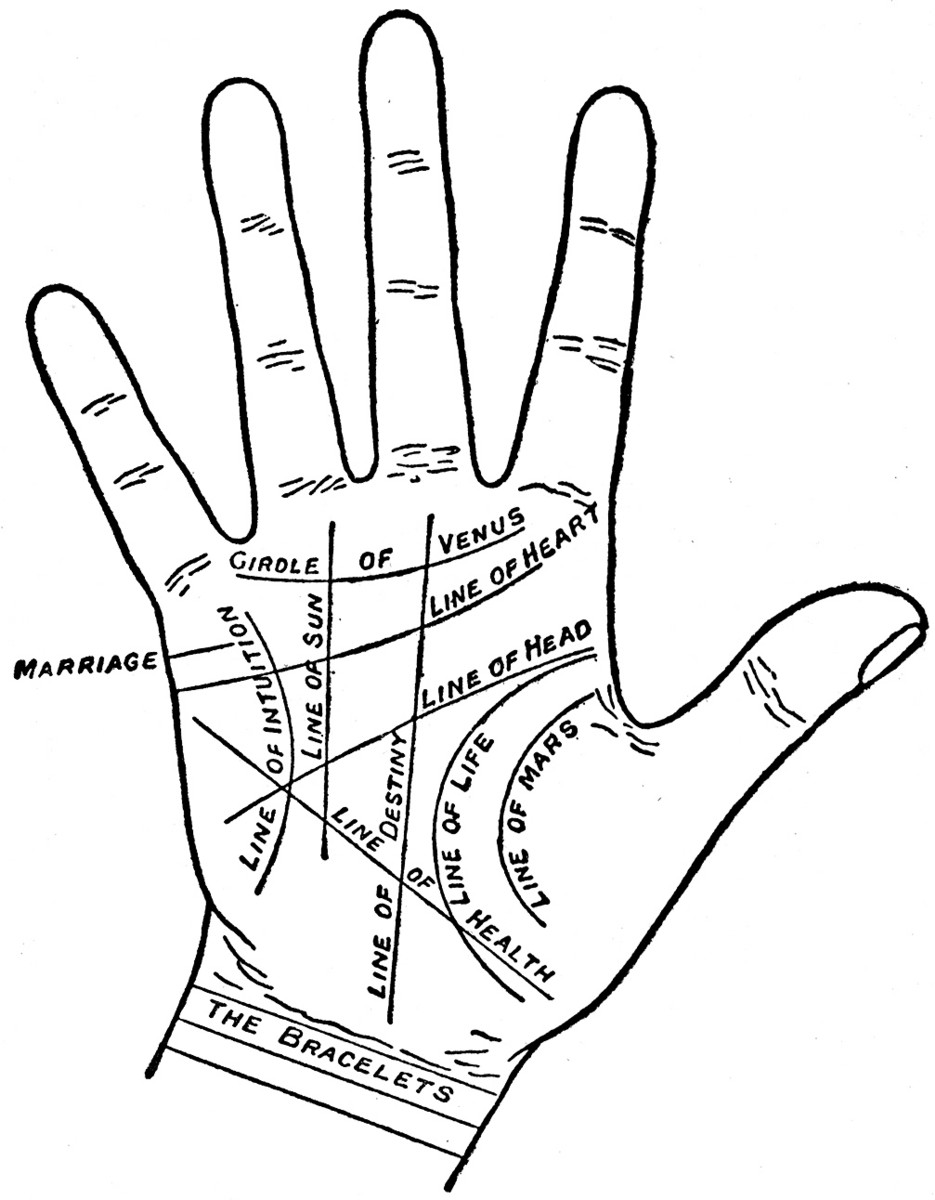
The classic palmistry overview from Cheiro's Palmistry for All (1916, public domain). Travel lines are short horizontal lines on the percussion edge — the outer side of the palm opposite the thumb.
Where to Find Travel Lines
Hold your hand flat, palm up. Look at the outer edge of your hand — the side below the little finger, away from the thumb. This edge is called the percussion edge because it is the side you would use to strike a surface.
Travel lines are short lines that run horizontally from the edge inward, crossing toward the center of the palm. They are usually found in the lower-to-middle portion of the percussion edge, in the area near the fate line.
They may be:
- One or two faint lines — barely visible under normal lighting
- Several clear lines — easy to see, running parallel to each other
- Completely absent — no visible lines on the percussion edge at all
Check both hands. Many people have no travel lines on either hand, and that is perfectly normal.
How to Read Travel Lines
When travel lines are present, the reading depends on their depth, direction, and position relative to other lines on the palm.
Depth and clarity
Deep, clear travel lines are read as significant journeys — the kind that change a life direction. An international move, a permanent relocation, a long trip that shifted the person's perspective or career. The deeper the line, the more impactful the journey.
Faint travel lines are read as shorter or less consequential trips — vacations, business travel, temporary relocations. These are real journeys, but they did not fundamentally alter the person's life path.
Direction: straight vs. curved
A straight horizontal travel line — running cleanly from the edge inward — is traditionally read as a journey with a return. The person traveled and came back, or the relocation was temporary.
A travel line that curves upward toward the fingers is read as emigration or a permanent move. The person did not return to their starting point. The curve signals a change of base, not just a trip.
Crossing the fate line
When a travel line crosses the fate line, it is read as a journey that had a direct impact on the person's career or life direction. A move that led to a new job, a trip that opened a new career path, a relocation that changed everything. The crossing point gives a rough indication of when — lines closer to the wrist correspond to earlier life, lines closer to the fingers correspond to later.
Crossing the head line
When a travel line crosses the head line, the impact is read as intellectual or psychological rather than career-based. The journey changed how the person thinks, what they believe, or how they see the world. Study abroad, a spiritual journey, or a trip that opened new perspectives.
Number of travel lines
Some people have one or two travel lines. Some have five or six. Neither is better. A person with many travel lines has moved or traveled frequently. A person with none has stayed closer to home. Both are valid life patterns.
Position along the edge
Travel lines found higher on the percussion edge (closer to the fingers) are traditionally read as journeys taken in youth or early adulthood. Lines found lower (closer to the wrist) correspond to later life. This dating is rough and should not be taken literally.
Travel Lines and the Fate Line
The most interesting reading of travel lines happens when they interact with the fate line. The fate line — running vertically from the wrist toward the middle finger — describes career direction and external structure. When a travel line crosses it, the reading combines movement with career impact.
- A travel line crossing a strong fate line = a journey that reinforced or redirected a clear career path
- A travel line crossing a faint or broken fate line = a journey during a period of career uncertainty that may have helped resolve it
- A travel line crossing the fate line at the head line level = a journey around mid-life that changed both career and thinking
These intersections are the most readable travel line features, because they connect to the more reliable fate line.
Reading Travel Lines on Both Hands
The dominant / non-dominant rule from the main palm reading guide applies. The dominant (writing) hand shows journeys you have actually taken or are currently living. The non-dominant hand shows potential, desire, or inherited patterns of movement.
When travel lines appear on both hands, the person has traveled and is likely to continue. When they appear only on the non-dominant hand, there may be a strong desire to travel that has not yet been fulfilled. When they appear only on the dominant hand, the person has traveled but may not feel the same pull in the future.
An Honest Note: How Reliable Are Travel Lines?
Travel lines are among the least reliable features in palmistry. Here is why:
- They are often faint and easy to confuse with skin creases, especially on the percussion edge where the skin folds naturally.
- They are difficult to date. The rough position-to-age mapping is unreliable, and different authors place the age boundaries differently.
- Classical authors treated them as minor. Cheiro mentions travel lines in passing but does not build readings around them. They are supplementary details, not central features.
- Confirmation bias is strong. People who want to travel tend to find lines; people who do not care tend not to look. This makes travel line readings particularly prone to wishful thinking.
This does not mean travel lines are meaningless. When clear, deep, and unambiguous, they do seem to correlate with significant journeys in the person's life. But they should be read as interesting supplementary notes, not as reliable predictions. If you have no travel lines, it does not mean you will never travel. If you have several, it does not guarantee any specific journey.
Limits: What Travel Lines Cannot Tell You
- Where you will travel. Travel lines do not encode destinations. No feature on the hand can tell you which country or city you will visit.
- When you will travel. The rough position-to-age mapping is too unreliable for specific dates or even specific years.
- Whether a specific trip will happen. Travel lines describe patterns, not specific future events. A line that looks like a journey may correspond to one already taken.
- Whether you should travel. Travel lines are descriptive, not prescriptive. They do not tell you what to do.
- Whether a relocation will be permanent. The curved-vs-straight distinction is suggestive but not reliable enough to base decisions on.
What travel lines can offer, when clear and unambiguous, is a general pattern of significant movement in a person's life — how much, how impactful, and roughly when. Read at that level, they add a small piece to the picture. Read past that, you are over-interpreting.
Frequently Asked Questions
Where are the travel lines on the palm?
Travel lines are short horizontal lines found on the percussion edge of the palm — the outer edge on the side of the hand opposite the thumb. They run from the edge of the hand inward, crossing toward the center of the palm.
Does everyone have travel lines?
No. Many people have no visible travel lines at all, and that is completely normal. The absence of travel lines does not mean you will never travel — it simply means that long-distance journeys or major relocations are not a prominent feature of your life pattern.
What do deep travel lines mean?
A deep, clear travel line is classically read as a significant journey or relocation — a life-changing trip, an international move, or a long-distance change of residence. The deeper the line, the more impactful the journey.
What do faint travel lines mean?
Faint travel lines are read as shorter trips, vacations, or journeys that were enjoyable but did not fundamentally change the person's life direction. They mark travel, but not transformative travel.
What does a travel line curving toward the fingers mean?
A travel line that curves upward toward the fingers is traditionally read as emigration or a permanent relocation — the person does not return to their starting point. A straight horizontal line is more often read as a journey with a return.
What does it mean when a travel line crosses the fate line?
When a travel line intersects the fate line, it is read as a journey that had a significant impact on the person's career or life direction. The crossing point gives a rough indication of when this happened.
Are travel lines reliable in palmistry?
Honestly, travel lines are among the least reliable features in palmistry. They are faint, easily confused with other lines, and difficult to date. Classical authors including Cheiro treated them as minor features — worth noting but not worth building a reading around.
Which hand should I read for travel lines?
Read the dominant (writing) hand for journeys you have already taken or are currently planning. The non-dominant hand shows potential or desire for travel. If travel lines appear only on the non-dominant hand, the person may have a strong wish to travel that has not yet been fulfilled.
Where to Go Next
If you want the full framework — hand shape, thumb, mounts, all four major lines, the dating method, and the mistakes most beginners make — read the 9-step palm reading guide. Travel lines are a minor feature; the major lines tell you far more about the shape of a life.
For the career direction side of the hand — the line that travel lines most often interact with — see the fate line guide. The fate line describes where your energy and career are directed, and when travel lines cross it, the reading becomes more specific.
For the vitality and health side — how travel and change affect your physical reserves — see the health line guide. Major moves and relocations take a toll on the body, and the health line adds context.
If you want a structured reading of your own palm in about a minute, scan your hand on the Scan page. It walks through the same classical framework this guide draws from and flags the travel markers it finds.
Image credits. All plates on this page are reproduced from Cheiro's Palmistry for All (G.P. Putnam's Sons, 1916), now in the public domain. Scans courtesy of Project Gutenberg.