
Life Line Palm Reading: Where It Sits and What Each Pattern Means
A practical guide to life line palm reading — where the life line sits, how its length, curve, and markings change the meaning, and what each classical pattern actually tells you about vitality and life path.
What does the life line tell you, and how do you read it? Hold your hand flat, palm up, and find the long arc curving around the base of your thumb — that is the life line. It describes vitality, physical energy, and the general shape of someone's life path — not how long they will live. A short life line does not mean a short life, despite what popular myths claim.
This guide describes the Cheiro / Indian-tradition reading of the life line, treats it as a vitality and life-direction marker rather than a lifespan predictor, and is honest about the limits — the same tone as the 9-step palm reading guide and the heart line guide. If you finish this page, you will know how the life line's length, curve, depth, and markings each change the reading, and where the tradition genuinely overreaches.
What Is the Life Line in Palm Reading?
The life line is the longest and most visible line on the palm — a sweeping arc that curves around the fleshy pad at the base of the thumb (the Venus mount). It usually starts in the web between the thumb and index finger, then curves down toward the wrist. It is the line closest to the thumb, sitting below the head line and below the heart line.
Where the heart line records how someone loves and the head line records how they think, the life line records how they live — their physical vitality, their general life direction, and the rhythm of their energy over time. Cheiro treats it in Palmistry for All (1916) as the line that governs "the vital force, the physical energy, and the general course of life." It is the most widely recognized line on the hand, and also the most misunderstood.
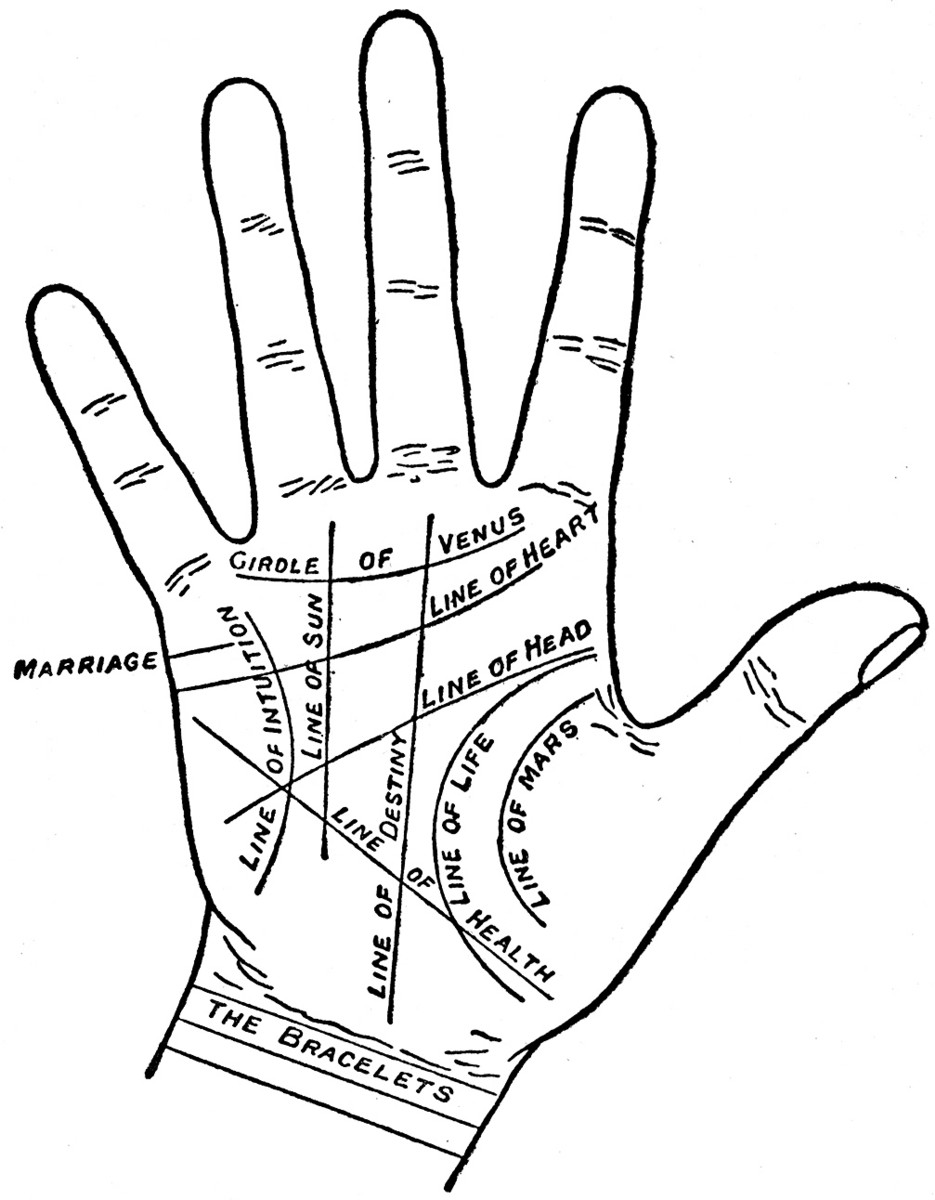
The classic palmistry overview from Cheiro's Palmistry for All (1916, public domain). The life line is the long arc sweeping around the Venus mount at the base of the thumb.
Where the Life Line Sits on Your Hand
Hold your hand flat, palm up. The life line is the long curved line that sweeps around the fleshy pad at the base of your thumb. It usually begins in the web between the thumb and index finger, then curves down across the palm toward the wrist. The fleshy area it encloses is the Venus mount — the mount of vitality, warmth, and physical energy.
A common beginner mistake is to confuse the life line with the head line, which sits directly above it. The head line runs more horizontally across the middle of the palm; the life line curves around the thumb. If you can find the line that is closest to the thumb and sweeps in an arc, that is the life line.
Another common source of confusion is the fate line — a vertical line running from the wrist toward the middle finger. The fate line relates to career and external direction; the life line relates to vitality and personal energy. They are distinct lines that sometimes cross, but they mean different things.
Which Direction to Read the Life Line
The life line is read from the web between the thumb and index finger, down toward the wrist. The starting point near the index finger corresponds roughly to early adulthood, and the line progresses downward toward the wrist as age advances. Like all palm dating, this is a rough guide — a general age band rather than a precise year.
The depth and clarity of the line at different points along its length tells you about the quality of vitality during those life stages. A deep, clear section marks a period of strong energy and good health; a faint or chained section marks a period of lower vitality or life disruption.
What Does the Life Line Mean in Palm Reading?
The life line describes three things, in order of reliability:
-
Vitality and physical energy. A deep, well-defined life line marks strong physical constitution and high energy. A faint or shallow line marks a more delicate constitution — not sickly, but someone whose energy needs careful management.
-
Life direction and major changes. Breaks, forks, and shifts in the life line's path mark significant life transitions — relocations, career changes, health events, or periods of reassessment. These are the markers palmists look for when someone asks "when did your life change?"
-
Emotional resilience. The width and depth of the arc tells you about a person's capacity to bounce back. A wide, sweeping curve enclosing a large Venus mount marks someone with deep reserves of warmth and vitality; a narrow, straight line running close to the thumb marks someone more self-contained and cautious.
What the life line does not describe is how long someone will live. This is the single most damaging myth in popular palmistry, and it has been explicitly rejected by every major classical author. Cheiro wrote in 1916: "The length of the Life Line has nothing whatever to do with the length of life."
Life Line Length: Long vs Short
The length of the life line is the feature that generates the most anxiety, so let me be direct: a short life line does not mean a short life.
Long life line
A life line that sweeps in a wide arc, enclosing a large portion of the palm, marks someone whose vitality and life energy are central to who they are. These people tend to be physically active, warm, enthusiastic, and deeply engaged with the world around them. The wider the arc, the more the person draws on physical and emotional energy as a core resource.
Short life line
A life line that stops partway down the palm — sometimes surprisingly short — does not indicate a shortened lifespan. Classical palmistry reads it as a more self-contained, independent approach to living. These people often change direction mid-life, take an unexpected path, or reinvent themselves at a point when others would stay the course.
In practice, a short life line frequently appears on people who made a major life change in their thirties or forties — a career shift, a move to a new country, a complete reorientation of priorities. The line does not end because life ends; it ends because the pattern of life changes.
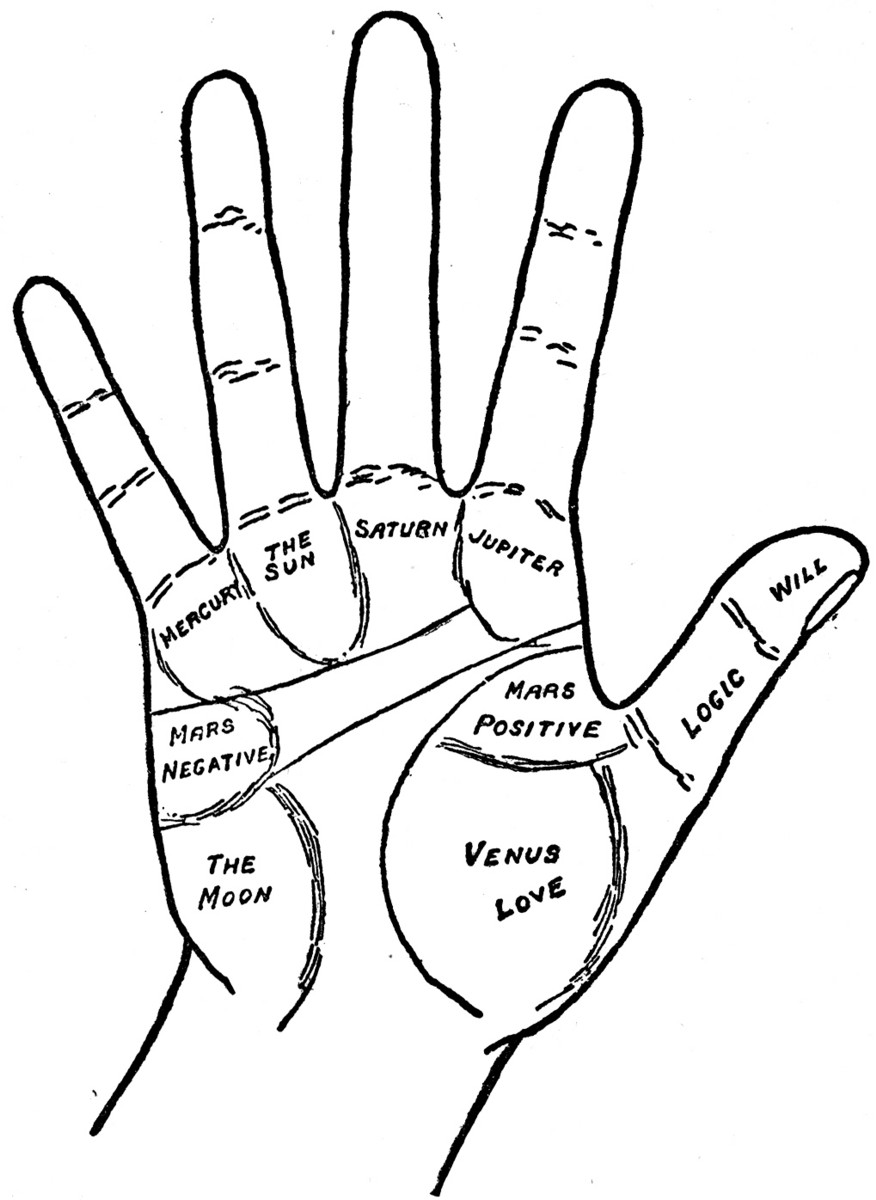
The seven mounts (Cheiro, 1916). The Venus mount at the base of the thumb is the fleshy area enclosed by the life line — its size and fullness complement the life line's own depth and length.
Life Line Depth and Clarity
Depth matters as much as length. A deep, clearly cut life line — a groove you can trace easily with your fingernail — marks strong, focused vitality. These people have consistent energy and tend to recover well from illness or setback. A faint or shallow line marks a more delicate constitution — not fragile, but someone whose energy fluctuates more and needs gentler management.
A broad, shallow life line — wide but not deep — often reads as someone who has physical energy but scatters it across many directions. They may start many projects without finishing them, or maintain a busy life without a clear central thread.
A very deep life line, almost like a scar, can indicate someone whose life has been shaped by a single defining experience or commitment. These people tend to be intensely focused and sometimes inflexible.
The Life Line Patterns Worth Knowing
Beyond length and depth, a handful of markings come up repeatedly on the life line. For each I give the classical reading and an honest note on where it gets over-read.
Broken life line
A clear break in the life line is the classical sign of a significant life change — a health event, a relocation, a career shift, or a period of crisis and recovery. If the two segments overlap, the reading is interruption followed by continuation — the person went through something major but came out the other side. A clean gap between the segments signals a more dramatic transition — a complete change of direction.
A break that appears on both hands in the same place is more significant than one that appears on only one hand. If only the dominant hand shows a break, the change is likely self-directed; if only the non-dominant hand shows it, the change may have been imposed by circumstances.
Chained life line
A chained life line — made of small linked loops, like a chain — reads as a period of low energy, divided vitality, or health struggles. It marks a stretch of life where the person's physical or emotional resources are stretched thin, often due to illness, stress, or an unsettled living situation.
The chain is not permanent. Once the line clears and resumes its normal depth, the difficult period has passed. I treat a chained section as a map of past or present difficulty, not a prediction of future weakness.
Island on the life line
An island — a small loop or oval in the middle of the life line — marks a difficult period, often involving health problems, fatigue, or a loss of direction. The larger the island, the longer or more significant the difficult stretch. Once the island closes and the line continues, the person's vitality recovers.
An island near the start of the life line (close to the index finger) often marks childhood illness or early-life disruption. An island in the middle section often marks a midlife health crisis or period of burnout. An island near the wrist may mark a late-life health concern.
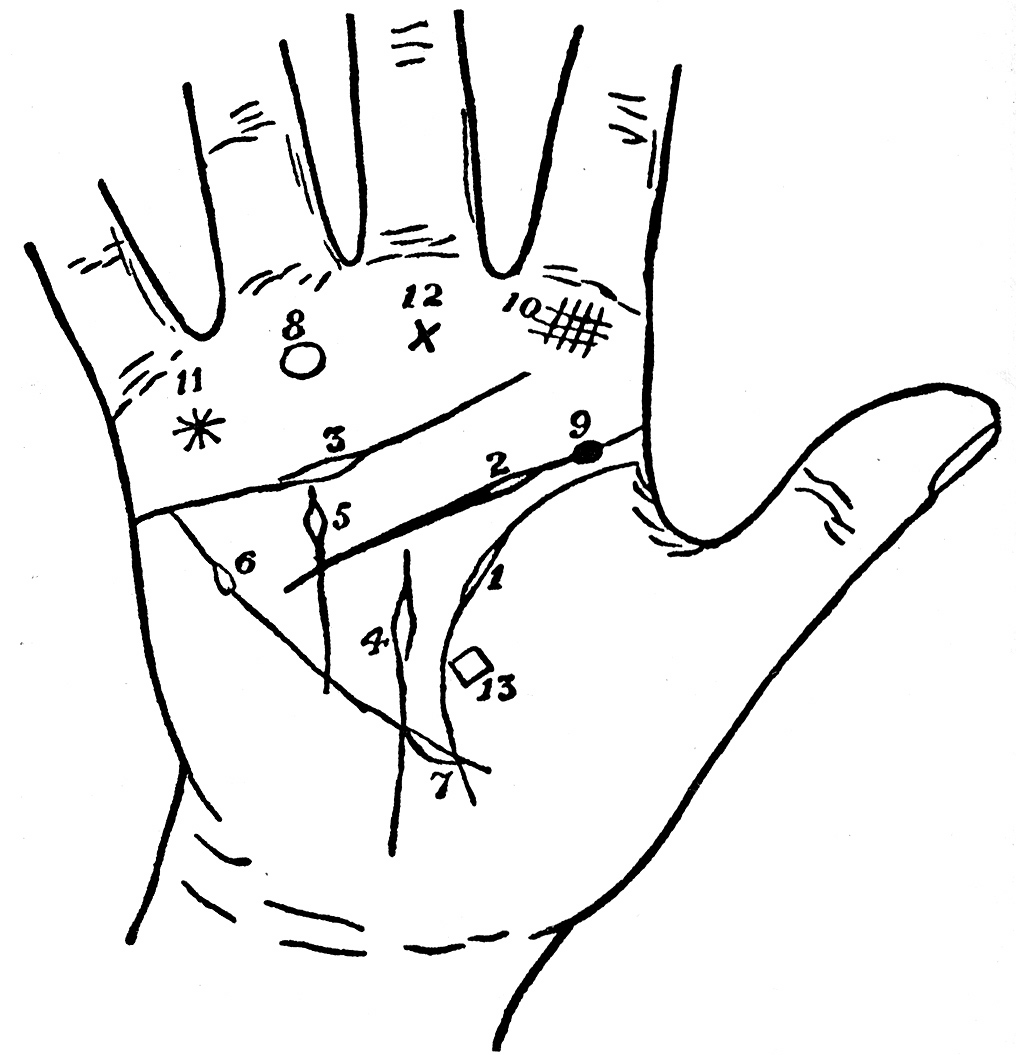
Cheiro Plate XXII — the six classical marks (island, circle, spot, grille, star, square) that can appear on the life line and modify its meaning.
Forked or split life line
A fork at the end of the life line, splitting toward the wrist, classically indicates a change of direction in later life — often a move, a career shift, or a broadening of interests. The wider the fork, the more dramatic the change. A narrow fork is a subtle adjustment; a wide fork is a complete reorientation.
A fork at the start of the life line, near the index finger, reads as a hesitant or divided beginning — someone who started adulthood pulled between two paths or two places. If the head line also forks, the person is likely genuinely torn between two ways of thinking.
A split in the middle of the life line — where the line appears to divide and then reconnects — marks a temporary divergence, not a permanent break. The person tried something different, then returned to their original path.
Double life line
A double life line — a second, thinner line running parallel inside the main line — is one of the most positive markings in palmistry. It indicates strong protection, resilience, and an extra reserve of vitality. People with a double life line tend to recover well from setbacks, have a strong immune system, and maintain their energy even under pressure.
The inner line acts as a support line, reinforcing the main life line's energy. If the main line shows a break, the double line can indicate that the person weathered the crisis with help — from family, a partner, or their own inner reserves. It is not a guarantee against difficulty, but it marks someone who bounces back.
Rising lines branching upward
Small lines branching upward off the life line are classically read as positive developments — good health, renewed energy, or a period of growth. Branches dropping downward read as periods of energy loss, disappointment, or health decline. In practice I treat a cluster of fine upward branches as a sign of an optimistic, energized temperament more than as a list of literal events.
Life Line and Head Line Connected
The relationship between the life line and the head line is one of the most informative features on the hand. The head line sits directly above the life line, and where they meet — or do not meet — changes the reading significantly.
Connected at the start
When the life line and head line share a common beginning, it marks a cautious, conventional temperament — someone who thinks carefully before acting, values security, and tends to follow established paths. The longer the connection, the longer the person stays close to family or tradition before striking out on their own.
Separate from the start
When the life line and head line begin apart, with a visible gap between them, it marks an independent, adventurous temperament — someone who thinks for themselves from an early age, takes risks, and is comfortable acting on instinct. A wide gap indicates a strong-willed, impulsive nature; a narrow gap is a milder version of the same quality.
Where they cross
The head line usually separates from the life line at some point along its length. The point where they diverge roughly corresponds to the age when the person became independent — left home, started their own career, or made a decisive break from their upbringing. This is one of the few timing markers on the hand that can be read with some confidence.
Life Line Age Chart — How to Date Events
Classical palmistry maps the life line across roughly ages 15 to 70, with the starting point near the index finger corresponding to early adulthood and the end near the wrist corresponding to later life. The line is divided proportionally, and events are dated by where a break, island, or fork appears along the arc.
This dating method is rough at best. Cheiro himself warned against over-precise dating, and most modern palmists treat it as a general age band — early adulthood, midlife, late midlife — rather than a specific year. The method works best for identifying whether an event happened in the first, middle, or last third of the line; beyond that, it is guessing.
A practical tip: if a break or island appears on both hands in approximately the same position, the dating is more reliable. If it appears on only one hand, the event may be a possibility rather than a certainty.
Which Hand to Read for the Life Line
The dominant / non-dominant rule from the main palm reading guide applies cleanly to the life line. The dominant (writing) hand shows your present-day reality — your life as you are living it now, including the choices you have made and the direction you have taken. The non-dominant hand shows your inherited vitality and the life pattern you were born with.
When both hands carry a similar life line — same length, same depth, same curve — the reading is strong and stable. The person is living in alignment with their natural energy and temperament. When the two hands disagree sharply — say, a short life line on the dominant hand and a long one on the non-dominant — the person is usually consciously reshaping their life direction, either moving away from an inherited pattern or narrowing their focus from a broader potential.
Reading the Life Line in Context
The life line is never read in isolation. Its relationship to the head line above it tells you about the balance between caution and independence. Its relationship to the heart line tells you about the balance between physical energy and emotional life. And the Venus mount it encloses — the fleshy pad at the base of the thumb — provides the backdrop: a full, well-developed Venus mount complements a strong life line, while a flat or hollow Venus mount may temper an otherwise positive reading.
A reading that treats the life line alone, without checking the head line, heart line, and Venus mount, is exactly the kind of reading that produces the dramatic, useless "predictions" that give palmistry a bad name.
Limits: What the Life Line Cannot Tell You
To match the honest-tradeoff tone of the rest of this site, here is what the life line cannot reliably tell you:
- How long you will live. This is the most common and most harmful myth about the life line. No classical text supports it. Cheiro wrote explicitly that the length of the life line has nothing to do with the length of life. A short life line marks a change of direction, not a shortened lifespan.
- When you will die. No line on the hand predicts death. Anyone who tells you otherwise is either misinformed or selling something.
- A specific medical diagnosis. An island, a break, or a chained section marks a period of difficulty — often health-related — but it does not name a disease or predict a specific medical event. Read it as a vitality marker, not a clinical finding.
- Whether you will have children. The life line is sometimes confused with the children lines, which are small vertical marks on the percussion edge below the pinky. These are separate features with separate meanings.
What the life line can describe is the rhythm of someone's vitality and life direction: strong or delicate, adventurous or cautious, stable or changeable, resilient or fragile. Read at that level, it is one of the most informative lines on the hand. Read past it, you are guessing.
Frequently Asked Questions
What does the life line mean in palm reading?
The life line is the long arc curving around the base of the thumb, running from between the thumb and index finger down toward the wrist. It describes vitality, physical energy, and the general shape of someone's life path — not how long they will live. A short life line does not mean a short life.
Where exactly is the life line on the hand?
Hold your hand flat, palm up. The life line is the long curved line that sweeps around the fleshy pad at the base of the thumb (the Venus mount). It usually starts in the web between the thumb and index finger and curves down toward the wrist. It is the line closest to the thumb.
What does a short life line mean in palm reading?
A short life line does not mean a short life. Classical palmistry reads it as a more self-contained, independent approach to living — someone who changes direction mid-life or takes a different path than expected. It has nothing to do with lifespan, despite what popular myths claim.
What does a broken life line mean?
A break in the life line classically marks a significant life change — a health event, a relocation, or a major shift in direction. If the two segments overlap, it usually means recovery and continuation; a clean gap signals a more dramatic transition. Only treat it as significant when the rest of the hand confirms the story.
What does a forked or split life line mean?
A fork at the end of the life line, splitting toward the wrist, classically indicates a change of direction in later life — often a move, a career shift, or a broadening of interests. A fork at the start, near the index finger, reads as a hesitant or divided beginning.
What does a double life line mean?
A double life line — a second, thinner line running parallel inside the main line — is one of the most positive markings in palmistry. It indicates strong protection, resilience, and an extra reserve of vitality. People with a double life line tend to recover well from setbacks.
Does a short life line mean early death?
No. This is the most damaging myth in palmistry. Cheiro himself wrote in 1916 that the life line has nothing to do with the length of life. A short life line marks a change in direction or a more independent path, not a shortened lifespan. No classical text supports the death prediction.
Which hand should I read for the life line?
Read the dominant — writing — hand for your present-day reality and life path as you are living it now. The non-dominant hand shows your inherited vitality and the life pattern you were born with. If the two disagree, the person is usually consciously reshaping their life direction.
What does a chained life line mean?
A chained life line — made of small linked loops — reads as a period of low energy, health struggles, or emotional turbulence. It marks a stretch of life where vitality is divided or weakened, not a permanent condition. Once the chain clears, the line continues with renewed strength.
What does an island on the life line mean?
An island on the life line — a small loop in the middle of the line — marks a difficult period, often involving health issues, fatigue, or a loss of direction. The classical reading treats it as temporary: once the island closes, the line continues, and so does the person's vitality.
Can the life line change over time?
Yes. The life line is one of the more changeable lines on the hand. It can deepen, lengthen, or develop new markings as life circumstances shift. It is reasonable to recheck it once a year rather than treat any single reading as permanent.
Is the life line the same as the fate line?
No. The life line curves around the base of the thumb and relates to vitality and life path. The fate line runs vertically from the wrist toward the middle finger and relates to career and external direction. They are distinct lines with different meanings.
What does a curved life line mean?
A life line that curves widely away from the thumb, enclosing a large Venus mount, indicates an enthusiastic, energetic, and warm temperament — someone with strong physical vitality and a love of life. A straighter life line, running closer to the thumb, marks a more cautious, self-controlled approach.
Where to Go Next
If you want the full framework — hand shape, thumb, mounts, all four major lines, the dating method, and the mistakes most beginners make — read the 9-step palm reading guide. The life line is one piece of a larger reading, and the head line directly above it changes its meaning more than any single marking does.
For the emotional side of the hand — how someone loves, feels, and connects — see the heart line guide. The life line tells you how someone lives; the heart line tells you how they love.
For the reputation and talent side — how you are recognized and what you are known for — see the sun line guide. The life line tells you how much energy someone has; the sun line tells you how visible their talent becomes.
For the relationship-specific markings — the short horizontal lines below the pinky — see the marriage line guide. The life line records the shape of someone's life; the marriage lines record the unions that formed within it.
If you want a structured reading of your own palm in about a minute, scan your hand on the Scan page. It walks through the same classical framework this guide draws from and flags the life-line patterns it finds.
Image credits. All plates on this page are reproduced from Cheiro's Palmistry for All (G.P. Putnam's Sons, 1916), now in the public domain. Scans courtesy of Project Gutenberg.
Heart Line Palm Reading: Where It Sits and What Each Pattern Means
A practical guide to heart line palm reading — where the heart line sits, how its ending point, curve, and length change the meaning, and what each classical pattern actually tells you about how someone loves.
Palm Reading Marriage Lines: How to Find Yours and What Each Pattern Means
A practical guide to palm reading marriage lines — where they sit on your hand, how to count and date them, and what each classical pattern actually tells you.