
Money Line Palm Reading: Where It Sits and What Each Pattern Means
A practical guide to money line palm reading — where the money line sits, how to find it, and what classical palmistry actually says about wealth markers on the hand.
Is there a money line on your palm, and what does it tell you? This is one of the most searched questions in palmistry — and one of the most misunderstood. The honest answer: there is no single, well-defined "money line" in classical palmistry. What modern palm readers call the money line is a set of features that, taken together, describe your relationship with money, business ability, and financial potential.
This guide describes what the tradition actually says about wealth markers on the hand, treats the "money line" as a collection of features rather than a single line, and is honest about the limits — the same tone as the 9-step palm reading guide and the fate line guide. If you finish this page, you will know which features on the hand are classically associated with money, where to find them, and why no single line can predict whether you will be rich.
What Is the Money Line in Palm Reading?
The term "money line" is a modern shorthand — not a classical Cheiro term. In Palmistry for All (1916), Cheiro does not use the phrase "money line" at all. Instead, he discusses financial potential through multiple features: the fate line (career direction), the Mount of Mercury (business ability), the head line (financial intelligence), and the overall hand shape (practical vs theoretical tendencies).
What modern palm readers call the "money line" usually refers to one or more of these features:
-
Short vertical lines on the Mount of Mercury — the fleshy pad under your little finger. These are the features most commonly called "money lines" in modern palm reading. When present and clear, they are classically associated with financial success and business ability.
-
A strong, deep fate line — a clear career path often correlates with financial stability, though it does not guarantee wealth.
-
A well-developed Mount of Jupiter — the fleshy pad under the index finger, associated with ambition, leadership, and the drive to accumulate wealth.
-
A deep, clear head line — associated with financial intelligence, strategic thinking, and the ability to make sound business decisions.
This article covers all four, starting with the features most commonly called "money lines."
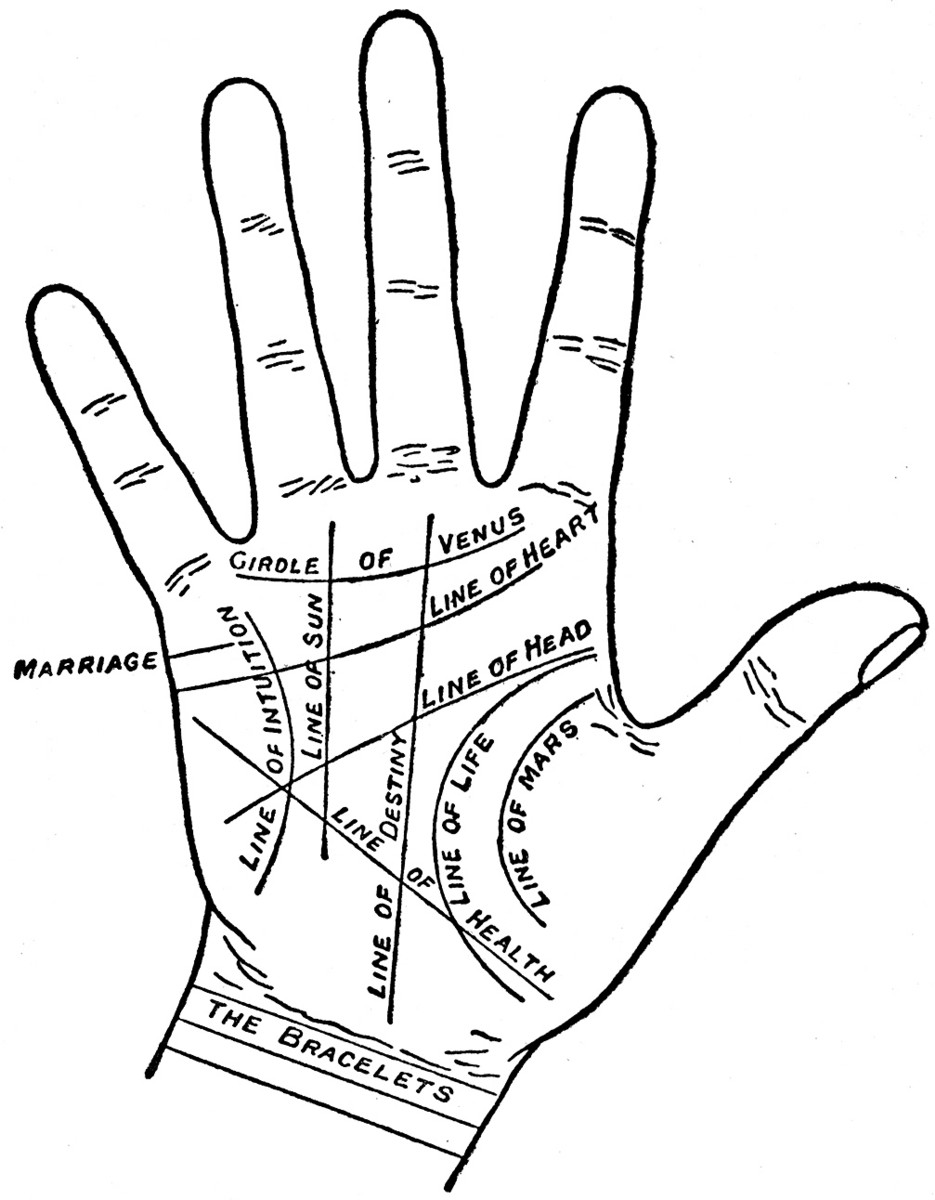
The classic palmistry overview from Cheiro's Palmistry for All (1916, public domain). Financial markers include the Mount of Mercury (under the little finger), the fate line, and the head line.
The Money Lines on the Mount of Mercury
The features most commonly called "money lines" are short vertical lines on the Mount of Mercury — the fleshy pad on the edge of your palm, directly under the little finger. These lines run parallel to each other, vertically, on the surface of the mount.
How to find them
Hold your hand flat, palm up, under good lighting. Look at the fleshy pad under your little finger. You may see one, two, three, or more short vertical lines running from the base of the finger downward toward the center of the palm. These are the classical money lines.
They are often faint — you may need to tilt your hand toward the light to see them clearly. Some people have none at all. Some have one or two. A few people have three or more clear lines.
What they mean
In the Cheiro tradition, the Mount of Mercury is associated with business ability, communication skill, and financial acumen. The vertical lines on this mount are read as indicators of financial potential:
- One clear line — moderate financial ability; the person is capable of earning and managing money but may not be driven by wealth accumulation.
- Two clear lines — stronger financial potential; the person has a natural head for business and can build wealth through skill and effort.
- Three or more clear lines — strong financial potential; the person is often described as having a "gift for money" — an intuitive understanding of business, investment, or wealth building.
What they do NOT mean
The money lines on the Mount of Mercury do not predict:
- Whether you will be rich or poor
- How much money you will earn
- When you will come into money
- Whether you will inherit wealth
They describe tendency and ability — a natural aptitude for financial matters — not outcome. A person with three clear money lines who makes poor financial decisions will still struggle. A person with no money lines who works hard and makes smart choices can still build significant wealth.
The Fate Line as a Wealth Marker
The fate line is the feature most often confused with a "money line" — and for good reason. A strong, deep fate line correlates with a clear career path, and a clear career path often leads to financial stability. But the fate line describes career direction, not wealth.
Strong fate line and money
When the fate line is deep, clear, and runs the full length of the palm, it marks someone whose career is well-defined and externally supported. These people often have stable jobs, clear professional roles, and steady income. The financial correlation is real — but it is indirect. The fate line creates the structure; the person's choices and circumstances determine the financial outcome.
Faint fate line and money
A faint or absent fate line does not mean poverty. It marks someone whose career path is more flexible and self-determined. These people may change careers, freelance, or build businesses in unconventional ways. Many entrepreneurs and self-made wealthy people have faint or absent fate lines — their financial success comes from independence and risk-taking, not from a clear career structure.
Fate line starting from the Mount of Mercury
In some hands, the fate line begins at or near the Mount of Mercury (under the little finger). This starting point is classically associated with careers in business, trade, communication, or finance — fields where the Mercury qualities of cleverness, adaptability, and commercial instinct are directly expressed. When a strong fate line starts from this area, it is read as a particularly strong indicator of business success.
The Head Line and Financial Intelligence
The head line — the horizontal line running across the center of the palm — is the feature most associated with financial intelligence and strategic thinking. While it is not a "money line" in the traditional sense, a strong head line is one of the most reliable indicators of the ability to make sound financial decisions.
Deep head line
A deep, clear head line marks someone who is analytical, strategic, and practical. These people tend to think before they act, plan their finances carefully, and avoid impulsive spending. They are good at managing money once they have it, even if they are not always good at earning it.
Long head line
A head line that extends far across the palm — reaching toward the percussion edge — marks someone with broad intellectual capacity and long-term thinking. These people can see the big picture, plan for the future, and make decisions that pay off over time. They are often good investors and strategists.
Head line and fate line connection
When the head line and fate line are connected or cross, it marks someone whose career is strongly shaped by their intellect. These people often succeed in fields that require mental skill — finance, law, engineering, consulting, or business strategy. The financial correlation is strong, because their career is built on the kind of thinking that leads to financial success.
The Mount of Jupiter and Ambition
The Mount of Jupiter — the fleshy pad under the index finger — is the feature most associated with ambition, leadership, and the drive to succeed. A well-developed Mount of Jupiter marks someone who is motivated by achievement, status, and material success.
Prominent Mount of Jupiter
When the Mount of Jupiter is well-developed — raised, firm, and clearly defined — it marks someone who is ambitious, confident, and driven. These people set high goals, work hard to achieve them, and are motivated by recognition and material reward. They are natural leaders and often accumulate wealth through sheer determination.
Flat Mount of Jupiter
A flat or undeveloped Mount of Jupiter marks someone who is less driven by ambition and material success. These people may be content with modest circumstances, or they may channel their energy into non-material pursuits — creativity, relationships, or personal growth. It does not mean they cannot be wealthy; it means wealth is not their primary motivator.
Mount of Jupiter and money
The Mount of Jupiter does not directly indicate financial outcome. But ambition and leadership — the Jupiter qualities — are among the strongest drivers of financial success. A person with a strong Mount of Jupiter and a strong fate line is classically read as having the drive and the structure to build significant wealth.
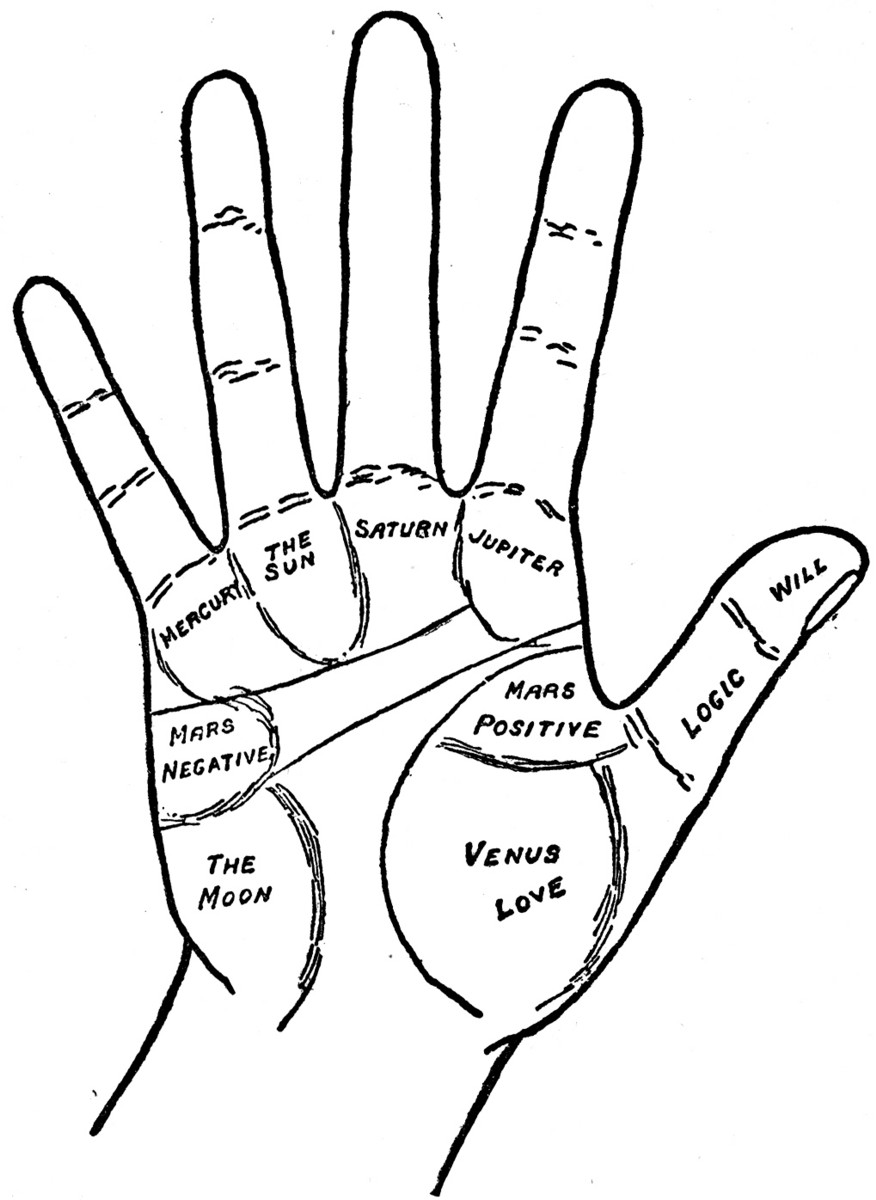
The seven mounts (Cheiro, 1916). The Mount of Jupiter (under the index finger) marks ambition; the Mount of Mercury (under the little finger) marks business ability and financial acumen.
Reading Money Lines on Both Hands
The dominant / non-dominant rule from the main palm reading guide applies to money markers. The dominant (writing) hand shows your present-day financial situation and career as you are living it now. The non-dominant hand shows the potential you were born with — the financial aptitude that was available before you made your choices.
When both hands carry similar money markers — clear lines on the Mount of Mercury, a strong fate line, a well-developed Mount of Jupiter — the reading is strong and stable. The person is living in alignment with their financial potential. When the two hands disagree — say, clear money lines on the non-dominant hand but none on the dominant — the person may have underutilized their natural financial ability, either by choice or by circumstance.
Hand Shape and Financial Tendency
The overall hand shape — described in the 9-step palm reading guide — adds context to the money markers. Different hand shapes have different relationships with money:
Earth hands (square palm, short fingers) — practical, grounded, and good with money. These people tend to be reliable earners and careful savers. They are not usually risk-takers, but they build wealth steadily through hard work and discipline.
Air hands (square palm, long fingers) — intellectual, communicative, and good at making money through ideas. These people are often drawn to business, writing, consulting, or technology. They can be excellent earners but may struggle with saving.
Water hands (long palm, short fingers) — intuitive, creative, and often less focused on money. These people may have strong financial intuition but are sometimes driven more by passion than profit.
Fire hands (long palm, long fingers) — ambitious, energetic, and often driven by achievement. These people can earn well but may spend freely. Their financial success often comes in bursts rather than steady accumulation.
Limits: What Money Lines Cannot Tell You
To match the honest-tradeoff tone of the rest of this site, here is what money markers on the hand cannot reliably tell you:
- Whether you will be rich or poor. No single line or feature on the hand can predict financial outcome. Wealth depends on education, opportunity, effort, circumstances, and luck — none of which are reliably readable from the palm.
- How much money you will earn. Specific financial figures are not encoded in the hand. The markers describe tendency and ability, not specific outcomes.
- When you will come into money. Financial timing — when you will get a raise, inherit money, or hit a business milestone — is not reliably dated from any palm feature.
- Whether you will inherit wealth. Inheritance is sometimes associated with specific fate line patterns, but this is one of the least reliable readings in palmistry. Do not take it seriously.
- Whether a specific investment will succeed. Palmistry describes personality and tendency, not the outcome of specific financial decisions. No palm feature can tell you whether a stock, business, or property will make money.
What money markers can describe is the structure of your relationship with money: whether you are naturally inclined toward financial thinking, whether your career supports wealth building, and whether your ambition drives you toward material success. Read at that level, the money markers add useful context to a palm reading. Read past them, you are guessing.
Frequently Asked Questions
Where is the money line in palm reading?
There is no single 'money line' in classical palmistry. Wealth markers include short vertical lines on the Mount of Mercury (under the little finger), a strong fate line, a deep head line, and a well-developed Mount of Jupiter. The small vertical lines below the little finger are the features most commonly called 'money lines' in modern palm reading.
What does the money line mean in palm reading?
The money line refers to short vertical lines on the Mount of Mercury — the fleshy pad under your little finger. These lines, when present and clear, are classically associated with financial success, business ability, and wealth accumulation. Not everyone has them, and their absence does not mean poverty.
How do I find the money line on my hand?
Look at the fleshy pad under your little finger (the Mount of Mercury). Short vertical lines running parallel to each other on this mount are the classical 'money lines.' They are often faint and may only appear under good lighting. Check both hands.
What does it mean if I have no money line?
No money lines on the Mount of Mercury is common and does not mean you will be poor. Wealth in palmistry is read from multiple markers — a strong fate line, a deep head line, a well-developed Mount of Jupiter, and the overall hand shape all contribute. A single feature never determines financial outcome.
Does a deep fate line mean I will be rich?
A deep fate line marks a clear career path and strong external direction, which can correlate with financial stability — but it does not guarantee wealth. The fate line describes career structure, not financial outcome. Many people with deep fate lines have modest incomes; many wealthy people have faint or absent fate lines.
Which hand should I read for money lines?
Read the dominant — writing — hand for your present-day financial situation and career. The non-dominant hand shows potential you were born with. If only one hand has clear money lines on the Mount of Mercury, the reading depends on which hand it is.
What does a money line going to the Mount of Jupiter mean?
In some modern palmistry traditions, a line running from the base of the palm toward the Mount of Jupiter (under the index finger) is called a 'money line' or 'wealth line.' This is not a standard classical feature, but when present, it is read as ambition, drive, and the potential for financial success through leadership or entrepreneurship.
Can the money line change over time?
Yes. The small vertical lines on the Mount of Mercury can appear, deepen, fade, or multiply over time as your financial situation changes. Like all palm features, they are not fixed — they develop as your life develops.
Is the money line the same as the fate line?
No. The fate line runs vertically from the wrist toward the middle finger and describes career direction. The money lines are short vertical lines on the Mount of Mercury (under the little finger) that are specifically associated with financial success. They are different features with different meanings.
What does three money lines on the palm mean?
Three clear vertical lines on the Mount of Mercury is traditionally read as a strong indicator of financial success and business ability. The more lines present and the clearer they are, the stronger the financial potential — though this is one marker among many, not a guarantee.
Does palm reading really predict wealth?
Palmistry describes tendencies and patterns, not guarantees. No single line or feature on the hand can reliably predict whether you will be wealthy. Financial outcome depends on education, opportunity, effort, and circumstances — palmistry can describe the structure of your approach to money, but it cannot predict the outcome.
What is the difference between money line and wealth line?
They are generally the same thing — different authors use different names for the same features. 'Money line' and 'wealth line' both refer to markers associated with financial success, most commonly the short vertical lines on the Mount of Mercury. Some authors also use these terms for the fate line or specific mounts.
Where to Go Next
If you want the full framework — hand shape, thumb, mounts, all four major lines, the dating method, and the mistakes most beginners make — read the 9-step palm reading guide. The money markers are one piece of a larger reading, and the hand shape and head line together tell you more about financial potential than any single feature.
For the career direction side of the hand — the line most directly tied to financial stability — see the fate line guide. The money lines describe financial aptitude; the fate line describes the career structure that puts that aptitude to work.
For the reputation and talent side — how you are recognized and what you are known for — see the sun line guide. Money and reputation often go hand in hand, and the sun line adds context to the financial picture.
If you want a structured reading of your own palm in about a minute, scan your hand on the Scan page. It walks through the same classical framework this guide draws from and flags the money markers it finds.
Image credits. All plates on this page are reproduced from Cheiro's Palmistry for All (G.P. Putnam's Sons, 1916), now in the public domain. Scans courtesy of Project Gutenberg.
Palm Reading Marriage Lines: How to Find Yours and What Each Pattern Means
A practical guide to palm reading marriage lines — where they sit on your hand, how to count and date them, and what each classical pattern actually tells you.
Sun Line in Palm Reading: Where It Sits and What Each Pattern Means
A practical guide to sun line palm reading — where the sun line sits, how its depth, length, and markings change the meaning, and what each classical pattern actually tells you about reputation, talent, and success.