
Health Line Palm Reading: Where It Sits and What It Tells You
A practical guide to health line palm reading — where the health line sits, whether you have one, and what classical palmistry actually says about health markers on the hand.
Does your hand show a health line, and what does it mean? The health line is one of the most talked-about features in modern palm reading — and one of the most misunderstood. Here is the honest answer: not everyone has one, and not having one is actually a good sign. The health line is a secondary feature in classical palmistry, not a primary diagnostic tool.
This guide covers where the health line sits, how to find it, what the different patterns mean in the Cheiro tradition, and where the limits are. The tone matches the 9-step palm reading guide and the fate line guide — practical, grounded, and honest about what the hand can and cannot tell you.
What Is the Health Line?
The health line is a diagonal line that runs from the Mount of Mercury (the fleshy pad under your little finger) down across the palm toward the Mount of Venus (the fleshy pad at the base of the thumb). It is not one of the four major lines — Cheiro in Palmistry for All (1916) classifies it as a secondary line, useful but subordinate to the life line, head line, heart line, and fate line.
The health line sits in the middle zone of the palm, between the head line above and the base of the palm below. It crosses through the area occupied by the fate line, and in some hands it runs roughly parallel to the life line on the other side.
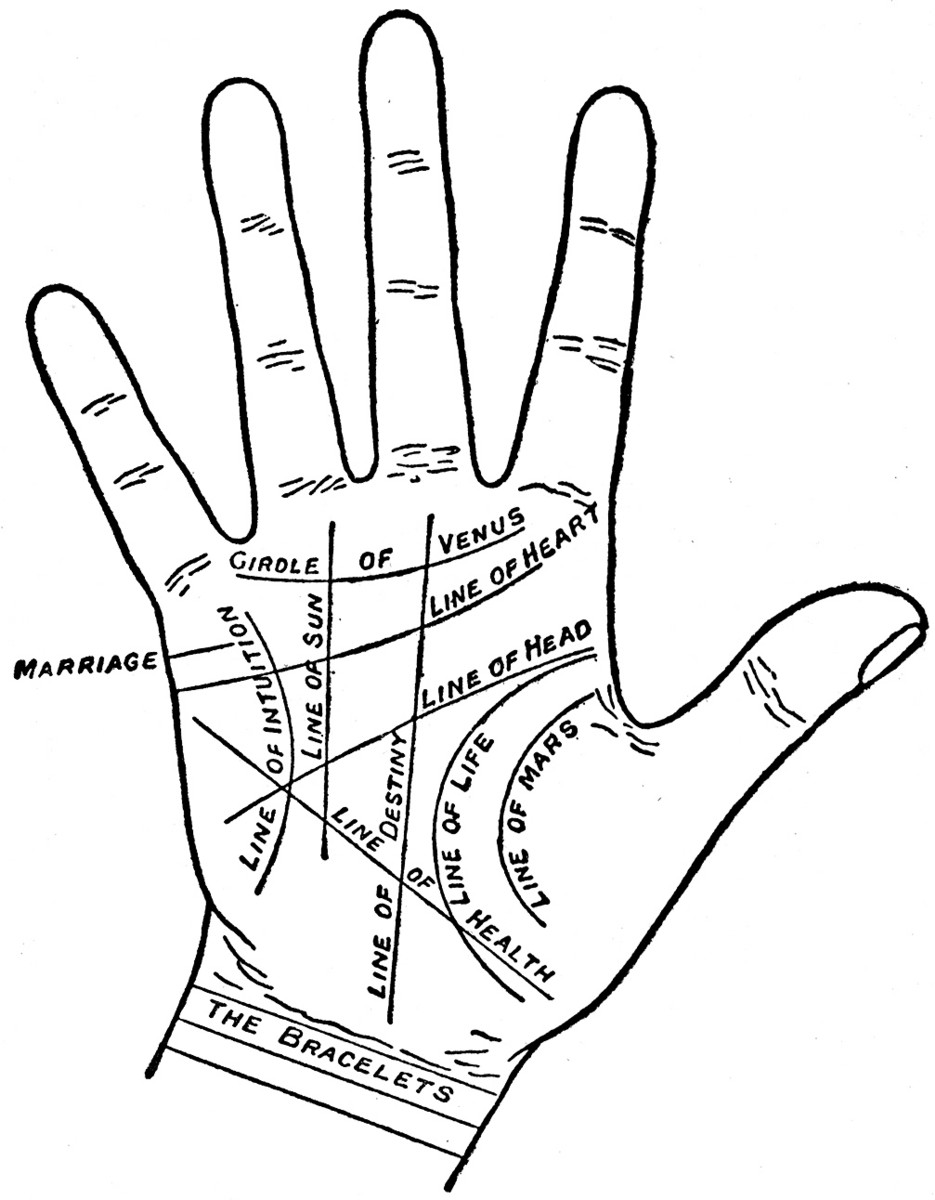
The classic palmistry overview from Cheiro's Palmistry for All (1916, public domain). The health line runs diagonally from the Mount of Mercury (under the little finger) toward the Mount of Venus (near the thumb).
Where to Find the Health Line
Hold your hand flat, palm up, under good lighting. Look at the fleshy pad under your little finger — the Mount of Mercury. From the base of the little finger, look for a diagonal line running down and across the palm, heading toward the thumb side.
The health line runs between the head line and the base of the palm, through the middle of the hand. It may be a single clear line, a faint shadow, or completely absent. Check both hands.
What if there is no health line?
This is the single most important thing to know about the health line: not having one is normal and good. In classical palmistry, the absence of a health line is read as strong vitality and robust health. The body does not need to signal weakness through the hand. Many perfectly healthy people have no health line at all. Do not go looking for a faint line that is not there.
How to Read the Health Line
When a health line is present, the reading depends on its depth, continuity, and markings. Here is the classical framework from the Cheiro tradition.
Deep and clear
A deep, well-defined health line is the best version. It marks strong constitution, physical resilience, and the ability to recover from illness or injury. These people tend to have good energy, bounce back quickly, and handle physical stress well. It does not mean they will never get sick — it means their body is fundamentally strong.
Faint or thin
A faint, barely visible health line is read as moderate vitality. These people may need to pay more attention to their health — diet, rest, exercise, and stress management matter more for them than for someone with a deep line. Faint does not mean sick; it means the constitution is not as robust and requires more care.
Broken
A broken health line — one that stops and restarts, with clear gaps — marks periods of health challenges. Each break is traditionally read as a time when the body struggled: illness, injury, surgery, or a period of low energy. The breaks do not predict future illness; they describe the pattern the body has already experienced.
Chained or looped
A chained health line — made up of small connected loops or circles, like a chain — is read as multiple minor health issues rather than one serious problem. These people may deal with a series of small complaints: colds, allergies, digestive issues, fatigue. The overall picture is not catastrophic but chronically inconvenient.
Islands
Islands — small oval loops that form within the line — are one of the more specific markers. In classical palmistry, an island on the health line marks a particular period of vulnerability. The position of the island along the line gives a rough indication of when in the person's life this period falls. An island near the Mercury end (little finger side) is read as affecting later life; one near the middle of the palm is read as mid-life.
Branches going down
Small lines branching downward from the health line are read as energy loss or periods of depletion. These mark times when the person's vitality was drained — by overwork, illness, stress, or poor lifestyle.
Branches going up
Small lines branching upward from the health line are read more positively — as recovery, renewed energy, or a period of improved health. An upward branch after a break or island suggests the person bounced back.
Crosses and stars
Crosses on the health line are read as sudden health shocks — accidents, acute illness, or unexpected crises. Stars (intersecting lines forming a small asterisk) are read similarly, marking a sharp event. Both are rare and should be read conservatively.
Wavy or irregular
A wavy health line — one that does not run straight but undulates up and down — is read as inconsistent vitality. These people may feel energetic one week and drained the next. The pattern is not about a single health event but about an uneven baseline. Stress, irregular sleep, and unstable routines tend to affect these people more than others.
Double health line
Occasionally, a hand shows two parallel health lines running close together. In classical palmistry, this is read as a particularly strong sign — double vitality, strong recovery power, and good physical reserves. It is rare and, when present, is considered one of the best health line configurations.
The Health Line and the Life Line
The health line does not exist in isolation. It should always be read in context with the life line — the curved line that arcs around the base of the thumb. The life line is the primary marker of vitality, physical energy, and the overall arc of bodily health. The health line is supplementary.
When both the life line and the health line are deep and clear, the reading is strong — robust constitution and good resilience. When the life line is strong but the health line is faint or broken, the person has good overall vitality but has experienced specific health challenges. When both are faint, the constitution is more delicate and health needs more attention.
Cheiro emphasizes in Indian Palmistry (1895) that the life line should always be read first and given more weight. The health line adds detail but does not override the life line's picture.
A note about the head line
The head line — the horizontal line running across the center of the palm — also plays a role in health readings. A strong, deep head line is associated with mental clarity and good decision-making, which indirectly supports health through better lifestyle choices. A very faint or broken head line, combined with a weak health line, can mark someone whose mental and physical health are both fragile. The head line does not replace the health line, but it adds context.
Hand Shape and Health Tendency
The overall hand shape — described in the 9-step palm reading guide — adds another layer to the health reading:
Earth hands (square palm, short fingers) — sturdy, grounded, and physically resilient. These people tend to have good stamina and recover well from illness. They may neglect health only because they rarely feel unwell.
Air hands (square palm, long fingers) — more prone to nervous tension, respiratory issues, and stress-related complaints. Their health is often fine physically but may suffer from mental strain and overthinking.
Water hands (long palm, short fingers) — sensitive, reactive, and more susceptible to emotional and hormonal fluctuations. Their health tends to mirror their emotional state.
Fire hands (long palm, long fingers) — energetic and resilient but prone to burnout. These people push hard and crash hard. Their health line often shows breaks that correspond to periods of overexertion.
Reading the Health Line on Both Hands
The dominant / non-dominant rule from the main palm reading guide applies here. The dominant (writing) hand shows your present-day health as it has developed. The non-dominant hand shows the constitution you were born with — your baseline vitality and inherited health tendencies.
When both hands show the same health line pattern — say, both are deep and clear — the reading is stable: the person has lived up to their inherited constitution. When the hands differ — a clear line on the non-dominant but a broken one on the dominant — it suggests the person's health has been shaped by lifestyle, choices, or circumstances beyond their inherited baseline.
Limits: What the Health Line Cannot Tell You
To match the honest tone of the rest of this site, here is what the health line cannot reliably tell you:
- Which specific illness you will get. The health line describes general vitality and constitution, not specific diagnoses. It cannot predict cancer, heart disease, diabetes, or any other condition.
- When you will get sick. Islands and breaks give a rough indication of vulnerability periods, but they are not reliable timelines. Do not use them to predict health events.
- Whether a current illness will resolve. The health line is not a medical instrument. It cannot track the progress of an existing condition.
- Whether you need to see a doctor. If you have health concerns, see a doctor. The health line is a tradition-based reading, not a diagnostic tool. It has zero medical validity.
- How long you will live. Longevity is not readable from the health line. The life line does not predict death, and neither does the health line.
What the health line can describe is the general pattern of your physical vitality — whether your constitution is robust or delicate, whether you have experienced periods of health challenge, and how resilient your body tends to be. Read at that level, it is a useful supplementary feature. Read past it, you are guessing.
Frequently Asked Questions
Where is the health line on the palm?
The health line runs diagonally from the Mount of Mercury (the fleshy pad under your little finger) down across the palm toward the Mount of Venus (the fleshy pad at the base of the thumb). It sits between the head line and the base of the palm, crossing through the middle zone of the hand.
Does everyone have a health line?
No. Many people do not have a health line at all, and in classical palmistry this is actually a good sign. The absence of a health line is traditionally read as strong vitality and a robust constitution — the body does not need to 'report' any weaknesses through the hand.
What does a deep health line mean?
A deep, clear health line is read in classical palmistry as a sign of robust physical constitution and strong vitality. It does not mean you will never get sick, but it marks someone whose body is resilient and recovers well.
What does a faint health line mean?
A faint or barely visible health line is traditionally read as a sign that the person should pay more attention to their health. It marks someone with moderate vitality who may need to be more careful about diet, rest, and lifestyle.
What does a broken health line mean?
A health line with breaks — gaps where the line stops and restarts — is classically read as periods of health challenges or recovery. The breaks mark times when the body has struggled, not a prediction of future illness.
What does a chained health line mean?
A chained or looped health line — made up of small connected circles — is read as multiple minor health issues rather than one major problem. These people may deal with a series of small complaints but are not necessarily seriously ill.
What do islands on the health line mean?
Islands — small oval loops within the health line — are classically read as specific vulnerability periods. The position of the island along the line corresponds to a rough time period in the person's life when health may be more fragile.
Can the health line predict specific diseases?
No. Classical palmistry cannot and does not predict specific illnesses from the health line. The line describes general vitality, constitution, and periods of vulnerability — not diagnoses. If you have health concerns, see a doctor.
Which hand should I read for the health line?
Read the dominant (writing) hand for your present-day health situation. The non-dominant hand shows inherited constitution and baseline vitality. If the health line differs between hands, the dominant hand tells you how your health has actually developed.
Is the health line a major line in palmistry?
No. Cheiro classified the health line as a secondary line, not one of the four major lines (heart, head, life, fate). It provides useful supplementary information about vitality, but it should always be read in context with the life line and overall hand condition.
Where to Go Next
If you want the full framework — hand shape, thumb, mounts, all four major lines, the dating method, and the mistakes most beginners make — read the 9-step palm reading guide. The health line is one piece of a larger reading, and the life line tells you more about overall vitality than any secondary feature.
For the career and external direction side of the hand, see the fate line guide. Health and career are deeply connected, and the fate line adds context to how your energy is directed.
For the emotional side — how stress and feeling affect your physical health — see the heart line guide. Emotional patterns and physical health are intertwined, and the heart line describes the emotional terrain.
If you want a structured reading of your own palm in about a minute, scan your hand on the Scan page. It walks through the same classical framework this guide draws from and flags the health markers it finds.
Image credits. All plates on this page are reproduced from Cheiro's Palmistry for All (G.P. Putnam's Sons, 1916), now in the public domain. Scans courtesy of Project Gutenberg.
Head Line Palm Reading: Where It Sits and What Each Pattern Means
A practical guide to head line palm reading — where the head line sits, how its length, curve, and ending point change the meaning, and what each classical pattern tells you about how someone thinks.
Heart Line Palm Reading: Where It Sits and What Each Pattern Means
A practical guide to heart line palm reading — where the heart line sits, how its ending point, curve, and length change the meaning, and what each classical pattern actually tells you about how someone loves.